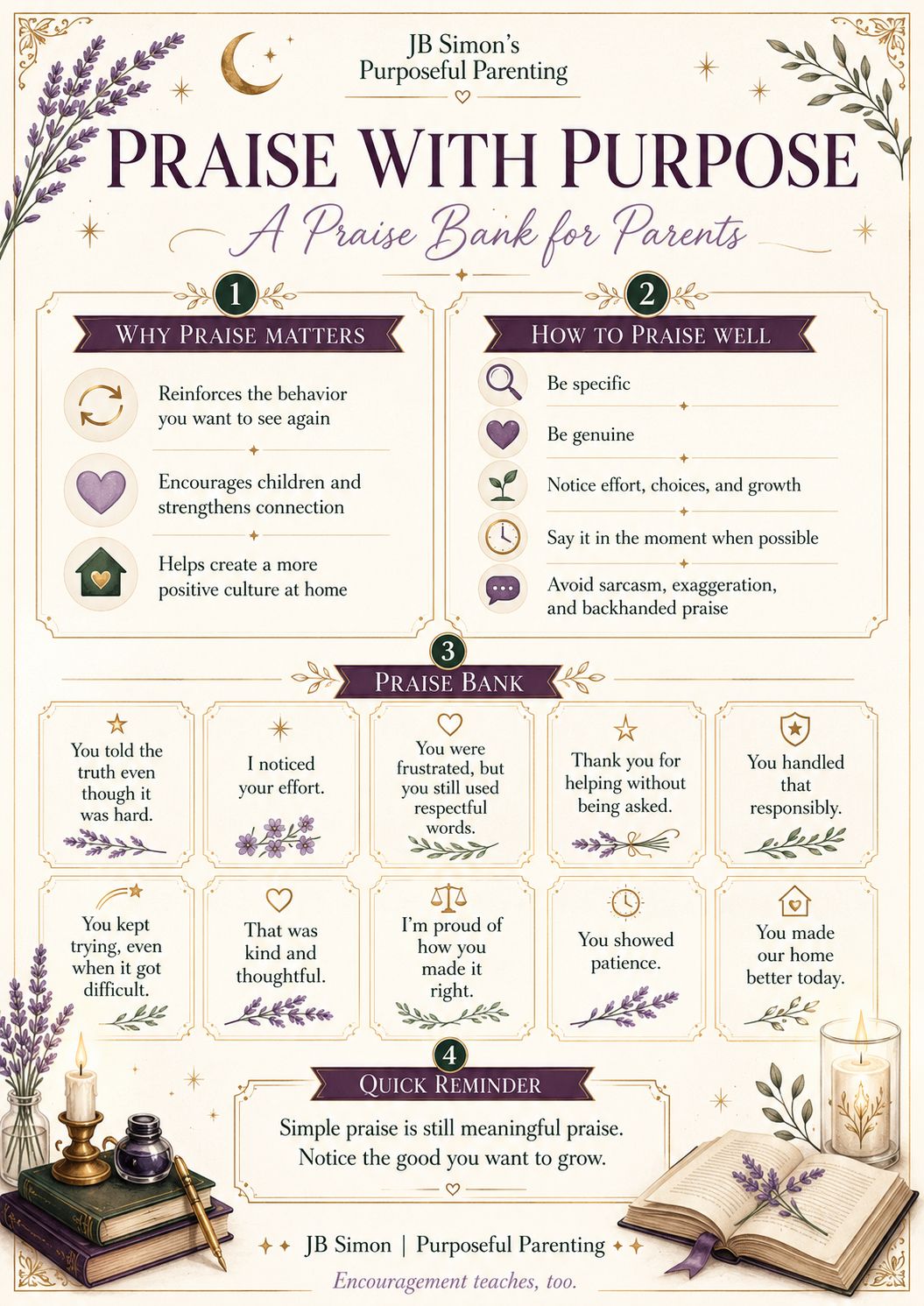
Looking for a simple way to encourage your child with more intention? This free Praise With Purpose printable is a quick parenting resource designed to help you notice the good, reinforce healthy behavior, and create a more positive culture at home.
Purposeful praise is not about exaggeration or empty compliments. It is about being specific, genuine, and encouraging. When we name effort, kindness, honesty, responsibility, patience, and growth, we help children understand what matters and which behaviors to practice again.
This free handout includes why praise matters, guidance for praising well, and a practical Praise Bank with examples you can begin using right away.
Tap or click the image to open the full-size printable.
Praise should not be random, exaggerated, or reserved only for major accomplishments. We should praise with intention.
There are many reasons to praise our children—and the people around us. Praise can reinforce healthy behavior, encourage someone who may be struggling, strengthen relationships, and teach us to become more observant, humble, and emotionally available.
The goal is not to flatter people or constantly announce that everything they do is amazing. The goal is to notice what is good, name it honestly, and encourage it to grow.
1. Praise Reinforces the Behavior We Want to See Again
In behavioral science, reinforcement is anything that increases the likelihood that a behavior will happen again. Praise can serve as a form of social reinforcement when it is connected to a specific behavior and matters to the person receiving it.
“Behavior that gets reinforced is more likely to happen again.”
When children demonstrate honesty, kindness, responsibility, patience, discipline, or self-control, those moments deserve attention.
Praise them when they tell the truth, especially when the truth is difficult. Praise them when they follow instructions without repeated arguing, keep their hands to themselves while angry, show kindness to a sibling, include someone who feels left out, admit a mistake, complete a responsibility, calm themselves after becoming upset, try again after failing, or make a wise choice when no one appears to be watching.
We often become highly observant when something goes wrong. We notice the shoes left in the hallway, the unfinished homework, the disrespectful tone, and the cup abandoned on the counter as though the kitchen fairy will eventually handle it.
But the good needs attention too.
As JB Simon explains in Purposeful Parenting Basics:
“Specific praise tells the child exactly what behavior to repeat.”
Instead of saying only, “Good job,” state what you noticed:
“You told the truth even though you thought you might get in trouble.”
“You were frustrated, but you still used respectful words.”
“I noticed that you helped your brother without being asked.”
“You kept working even when the assignment became difficult.”
“You cleaned up what you used. That was responsible.”
“You apologized and tried to repair what happened.”
Praise helps children connect their choices with the values we are trying to teach.
When we praise honesty, we strengthen honesty. When we praise self-control, we strengthen self-control. When we praise kindness, responsibility, perseverance, and repair, we communicate that these qualities matter in our home.
2. Praise Because People Need Encouragement
Not every encouraging word needs to be attached to a behavior plan.
Sometimes we praise simply because we want to be encouragers.
People often say, “You never know what a stranger is going through.” That is true—but heads up: you do not always know what the people living in your own home are going through either.
Your child may be dealing with embarrassment, rejection, insecurity, academic pressure, friendship problems, fear, grief, or questions they do not yet know how to express. Your spouse, friend, parent, coworker, or sibling may also be carrying something quietly.
We should not assume that proximity gives us complete access to another person’s internal world.
Children need adults who are willing to become their cheerleaders, sources of encouragement, and places of emotional safety. At the very least, that is what we should be striving to become.
“Connection is strengthened when we demonstrate love through patience, kind words, encouragement, affection, and a calm, steady presence.”
Praise is one way to communicate:
I see you.
I notice your effort.
Your growth matters.
Your presence has value.
You are more than your mistakes.
You do not have to perform perfectly to be loved.
That does not mean removing boundaries or pretending poor behavior is acceptable. Connection and correction can exist together.
As the same article reminds us:
“Correction may address the behavior in front of you, but connection helps shape the relationship beneath it.”
3. Praise Helps Adults Grow Too
Giving praise is not only beneficial for children. It also changes the adult giving it.
Intentional praise teaches us to slow down and observe.
What is my child doing well?
What progress have I ignored because it is not perfect yet?
Am I giving more attention to mistakes than growth?
Do the people in my home know what I appreciate about them?
Am I comfortable expressing positive emotions?
Do I believe people should “just know” that I love and value them?
Praise can require humility because it means acknowledging another person’s effort, growth, wisdom, or contribution. It can require vulnerability because some adults feel deeply uncomfortable saying, “I am proud of you,” “I appreciate you,” or “You handled that well.”
Perhaps your parents did not praise you. Perhaps affection and encouragement were rare in your home. Perhaps you were raised around criticism, sarcasm, emotional distance, or the belief that children should not be thanked for doing what they were supposed to do.
“Some people are learning the skill while trying to teach the skill.”
You may be learning how to encourage while raising a child who needs encouragement. You may be learning emotional expression while teaching your child to express emotions. You may be building a healthier household culture without having experienced one yourself.
That will feel awkward at first.
Do it anyway.
Praise Must Be Genuine
Children may appear gullible at times, but they can also be remarkably perceptive. They often recognize sarcasm, forced enthusiasm, manipulation, and praise that does not match reality.
Purposeful praise should be genuine, specific, timely, proportionate, and connected to effort, choices, values, or growth. It should be offered without sarcasm or a hidden insult.
Avoid exaggerated statements such as “You are perfect,” “You are the best at everything,” or “Look who finally decided to clean up.”
That last one is not praise. It is criticism wearing a party hat.
Try stating the obvious instead:
“You put your shoes away.”
“You remembered without being reminded.”
“You practiced patience with your sister.”
“You asked for help instead of giving up.”
“You handled that disappointment better than you did last time.”
“You made a mistake and took responsibility.”
Simple praise is still meaningful praise.
Create a Culture of Encouragement
You create the culture of your home.
As the parent and household leader, you help establish what becomes normal. If encouragement feels unfamiliar, begin practicing it until it becomes part of the family’s language.
“Ground rules are not about control. Ground rules are about teaching.”
Praise is also teaching.
It teaches children which values matter. It teaches them how to recognize goodness in themselves and others. It teaches them how encouragement sounds so they can eventually offer it to siblings, friends, classmates, coworkers, partners, and their own children.
You can begin with a simple family goal: Notice and name one positive thing each day.
“Thank you for being patient.”
“I appreciate how you helped.”
“You showed courage today.”
“You were thoughtful.”
“I noticed your effort.”
“You handled that responsibly.”
“I enjoy spending time with you.”
“I love the way your mind works.”
“You made our home better today.”
The words do not need to be extravagant. They need to be sincere.
Use the Praise Bank
The accompanying Praise Bank infographic provides examples for moments when you feel lost, awkward, or unsure of what to say.
Use it as a starting point—not a script that must be recited perfectly.
Choose a sentence. Say it honestly. Be specific when possible.
Ignore the initial awkwardness and lean into the practice. What feels unfamiliar today can become the new normal tomorrow.
Author’s Note: This article was written by JB Simon and edited with AI-assisted support for grammar, clarity, structure, and flow. The ideas, voice, and professional perspective are the author’s own.
Educational Notice: This article is for general parenting and wellness education. It is not a substitute for individualized mental-health, medical, legal, or crisis support.
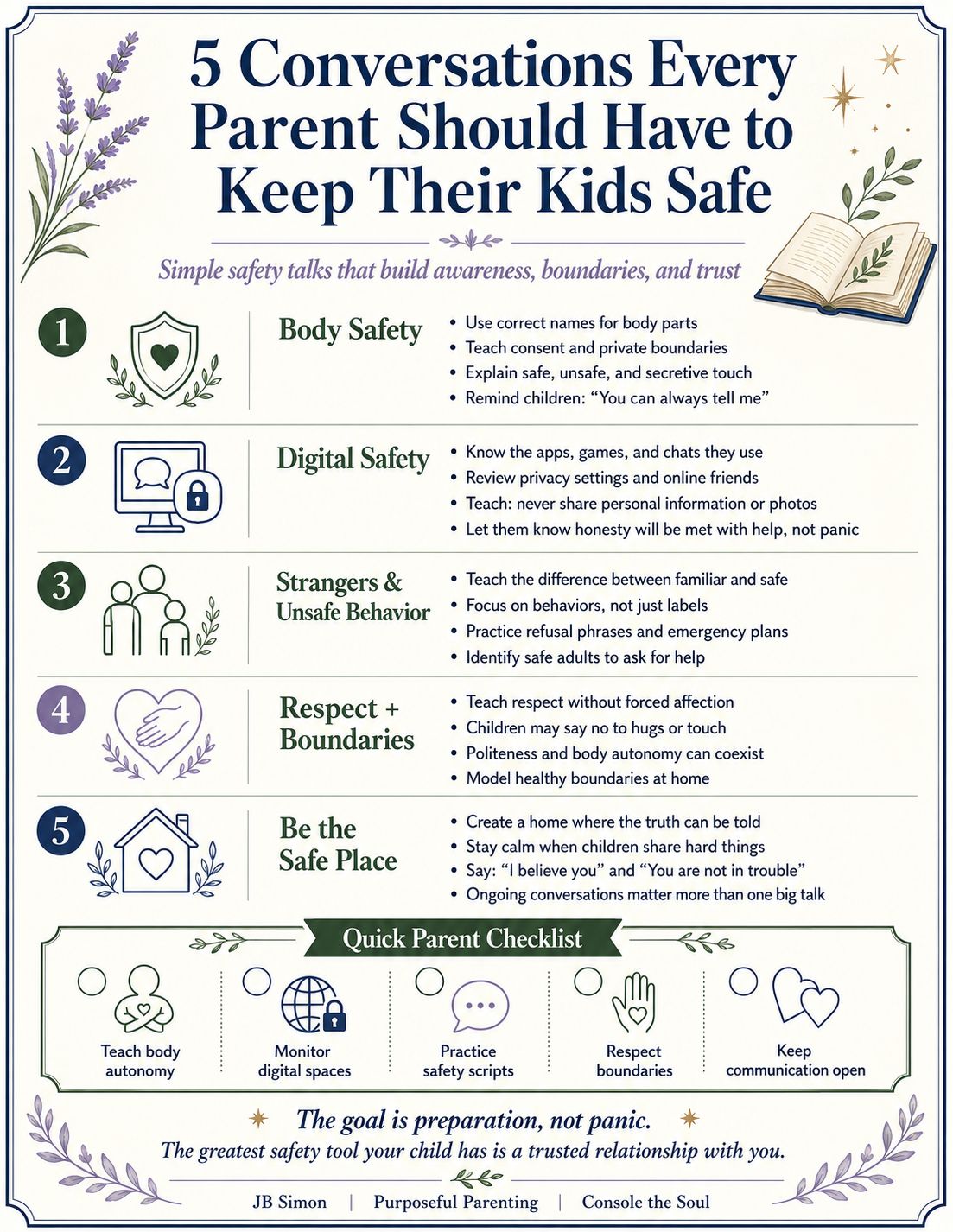
Parents do not need to approach child safety with panic. Children need calm, ongoing conversations that give them language, boundaries, confidence, and a safe adult they can always tell.
This free parent handout summarizes five essential safety conversations: body safety, digital safety, unsafe behavior, respectful boundaries, and becoming the safe place your child can come to.
Tap or click the infographic to open the full-size printable.
Keeping children safe is not about teaching them to fear everyone or treating the world like danger is hiding behind every corner. It is about giving them language, boundaries, confidence, and a dependable adult they can come to when something feels wrong.
Children cannot respond to situations they do not understand. They need more than one dramatic “safety talk.” They need calm, age-appropriate conversations that grow with them. These talks can happen in the car, during bath time, while watching television, after a news story, or when they begin using a new game or app.
The goal is preparation, not panic.
A Note from JB Simon
Most adults are not trying to hurt children, and healthy relationships should not be built on suspicion. However, children still need accurate information and clear boundaries. Education can help them recognize unsafe behavior, speak up sooner, and understand that abuse or manipulation is never their fault.
Healthy boundaries do not make children rude, fearful, or disrespectful. They help children become kind without becoming easy to pressure. Our children are “fearfully and wonderfully made” (Psalm 139:14). Teaching them to value and protect their bodies is part of teaching them that they matter.
1. Talk About Their Body, Consent, and Unsafe Touch
Use the correct names for body parts. Nicknames may feel more comfortable, but accurate language helps children communicate clearly if they are hurt, touched, or asked to do something inappropriate.
Teach that their body belongs to them. They may say no to unwanted hugs, kisses, tickling, lap-sitting, or other contact—even with relatives. Adults can teach politeness without demanding physical affection. A wave, fist bump, or verbal greeting is still respectful.
Explain the difference between safe, necessary, and unsafe touch. A caregiver helping with hygiene or a doctor completing an examination with permission and a trusted adult present is different from someone touching private areas for their own interest, asking a child to touch them, or requesting secrecy.
“You can always tell me if a touch makes you uncomfortable.”
“You will not be in trouble for telling the truth.”
“Surprises have an ending. Unsafe secrets are meant to keep you silent.”
“No one should ask to see or photograph the private parts covered by a swimsuit.”
As children mature, expand the conversation. Older children and teenagers need straightforward information about sexual pressure, bodily fluids, pregnancy, infections, and the exchange of genetic material involved in reproduction. This information should be factual, calm, and connected to consent, responsibility, faith, and personal values—not shame.
2. Know Their Digital World
Online safety is not solved by taking a phone at bedtime and assuming the problem is handled. Parents need to understand where children spend time, who can contact them, what information is visible, and how quickly conversations can move from a public game to a private platform.
Ask your child to show you how their favorite platforms work. Roblox, Minecraft, Fortnite, Discord, Snapchat, TikTok, YouTube, and other apps each have different chat, privacy, livestream, payment, and messaging features. You do not have to become a gaming expert. You do need to remain curious and involved.
Who can message you?
Can strangers join your game or server?
Have you ever been asked to move to another app?
Has anyone offered gifts, game currency, followers, or special access?
What would you do if someone asked for a photo, location, school name, or secret conversation?
Create rules before a problem occurs. Decide which apps are allowed, whether direct messages are permitted, when devices are put away, and what information may never be shared. Let your child know that reporting a frightening message will not automatically result in losing every device. When children believe honesty always leads to punishment, they may hide the very information parents need to know.
3. Redefine “Stranger Danger”
The old lesson was simple: strangers are dangerous. Real life is more complicated. A stranger may help a lost child, while an unsafe person may be familiar, charming, helpful, respected, or related to the family.
Teach children to focus on behavior rather than labels. A person is crossing a boundary when they ask a child to keep secrets from parents, isolate them, give unexplained gifts, discuss sexual topics, request private pictures, threaten consequences, or make the child feel responsible for the adult’s feelings.
Children also need a practical plan for emergencies. Identify “safer strangers” they may approach when lost: a uniformed employee, another parent with children, a police officer, a teacher, or a worker at an information desk. Teach your child your full name, phone number, and address when developmentally appropriate.
Practice simple phrases:
“I need to ask my parent first.”
“No. I am not going with you.”
“I do not keep secrets from my family.”
“Help! This is not my parent.”
4. Teach Respect Without Sacrificing Boundaries
Many children are taught to obey adults immediately, avoid embarrassing the family, and remain polite even when uncomfortable. Respect is important, but unquestioning compliance can make it harder for a child to resist pressure.
Teach the difference between being disrespectful and protecting a boundary. A child may speak firmly, move away, call a parent, or refuse an instruction that feels unsafe. They do not have to remain quiet to protect an adult’s feelings.
This requires adults to respect children’s reasonable boundaries at home. When a child says, “Please stop tickling me,” stopping teaches that their words matter. When parents knock before entering, avoid humiliating children, and apologize after crossing a line, children learn what respect should look like.
Clear family expectations also help children recognize inappropriate behavior. Read Ground Rules: The Peace Plan for Your Home for help creating boundaries that are firm, predictable, and peaceful.
5. Become the Safe Place They Can Tell
The most important safety conversation is the one that communicates: You can tell me anything.
Children may delay telling because they are embarrassed, confused, afraid of punishment, worried they will not be believed, or concerned that the family will fall apart. Your everyday reactions teach them whether you are safe to approach.
When your child shares something concerning, regulate yourself before interrogating them. Listen. Thank them for telling you. Remind them they are not in trouble. Avoid criticizing them for clicking a link, breaking a rule, accepting a gift, or waiting to speak. There will be time to address choices later. Safety comes first.
“I believe you.”
“Thank you for telling me.”
“This is not your fault.”
“You are not in trouble.”
“I am going to help keep you safe.”
Connection makes correction more effective. Children are more likely to bring difficult information to adults who are involved in their daily lives, listen without immediate judgment, and repair the relationship after conflict. Explore Connection Before Correction for more on becoming a steady, emotionally available parent.
A Simple Parent Safety Checklist
Use correct body-part names.
Teach consent and body autonomy.
Identify trusted adults your child may contact.
Review privacy settings and online friends regularly.
Keep devices out of bedrooms overnight when appropriate.
Practice refusal phrases and emergency plans.
Tell children they can report mistakes without losing your love.
Pay attention to sudden secrecy, fear, gifts, mood changes, or withdrawal.
Respond calmly when your child shares something difficult.
Keep the conversation ongoing as your child grows.
You cannot monitor every conversation, predict every situation, or remove every risk from your child’s life. That is not the goal. The goal is to raise a child who recognizes when something feels wrong, knows how to leave or ask for help, and trusts that home is a place where the truth can be told.
The greatest safety device your child will ever carry is not a phone, smartwatch, or tracking app. It is the confidence to recognize danger, the wisdom to trust their instincts, and the certainty that no matter what happens, they can always come home and tell you.
How clear expectations teach values, reduce chaos, and help children feel secure.
Hello all! Today’s article will cover the purpose of ground rules, the benefits of having them, and how to create them in a way that is simple, clear, and realistic.
Ground rules are appropriate for children, teens, and even adult family settings because every home, classroom, group, and relationship needs expectations. Not because we want to raise mindless robots, but because healthy order helps people function, communicate, and feel safe.
Many times, we assume things are common sense. We assume children should already know what not to do. We assume teens should understand boundaries. But children and teens are still learning. They need rules to be clearly stated, explained, modeled, and followed through with consistent consequences.
Ground Rules Are Love and Limits Working Together
According to the Positive Parenting curriculum, love and limits go together. Limits are part of nurturing children toward positive, productive futures. They communicate care, safety, responsibility, and security. The curriculum also describes limits as guardrails that help children feel secure while they learn how to behave responsibly.
This fits the heart of Purposeful Parenting: ground rules are not about control. Ground rules are about teaching.
The same curriculum explains that discipline means “to teach.” Good discipline is positive because it helps children learn what to do, not only what not to do. In other words, ground rules are one of the simplest ways to turn discipline from yelling into teaching.
1. Clarity
Many times, we assume something should be obvious. We assume children know what is rude, unsafe, disrespectful, too loud, too rough, or inappropriate. But children and teens need expectations stated clearly.
Ground rules answer simple but important questions:
What is allowed?
What is not allowed?
What happens when the rule is broken?
What does success look like?
The Positive Parenting handout on setting limits explains that clear limits tell a child exactly what is expected and when. Vague directions can leave children unsure of what to do.
Instead of saying, “Stop acting crazy,” say, “Walk in the house.”
Instead of saying, “Don’t be disrespectful,” say, “Use kind words.”
Instead of saying, “Stop making a mess,” say, “Food stays at the table.”
Children cannot follow rules they do not understand, and parents cannot enforce rules they have not clearly taught.
2. Chaos Control
Ground rules help address problem behaviors without giving every behavior too much attention.
When a home has no clear rules, everything becomes a debate. Everything becomes, “Stop that.” “Quit.” “I said no.” “How many times do I have to tell you?” And honestly, that gets exhausting.
Ground rules give parents a simple system.
Not random yelling.
Not empty threats.
Not frustration because no one is listening.
Not making up consequences in the heat of the moment.
Just this:
Here is the rule. Here is the behavior. Here is the consequence.
The Positive Parenting curriculum encourages positive limits, which means stating what children should do rather than only telling them what not to do.
Say: “Walk in the house.” Not: “Stop running!”
Say: “Use kind words.” Not: “Don’t cuss!”
Say: “Hands are for helping.” Not: “Stop hitting!”
Ground rules help you correct behavior without turning every moment into a full courtroom hearing.
3. A Lifeline of Peace in the Middle of Chaos
When the house is loud, emotions are high, and everyone is overstimulated, ground rules become a lifeline. They give the parent something steady to return to.
This is where your STEADY voice matters.
You do not have to yell. You do not have to repeat yourself ten times. You do not have to become frustrated because no one is listening. You do not have to make empty threats.
You simply identify the rule, state the consequence, and follow through.
“Since you are not following the rule about using kind words, the consequence is…”
“Since you chose to run in the house after being reminded, the consequence is…”
“Since the rule is homework before games, the game will wait until homework is done.”
The goal is not to overpower the child. The goal is to stay steady enough to teach.
A calm parent with a clear rule is more effective than an overwhelmed parent with twenty empty threats.
4. Installation of Values
Ground rules teach what matters.
Rules are not just about behavior. They are about values.
When you say, “Use kind words,” you are teaching respect.
When you say, “Tell the truth,” you are teaching honesty.
When you say, “Clean up what you use,” you are teaching responsibility.
When you say, “Ask before taking,” you are teaching boundaries.
When you say, “Hands are not for hurting,” you are teaching safety and self-control.
The Positive Parenting handout on setting limits explains that limits can protect children from physical harm, protect property, and protect children and others from psychological harm. That matters because good rules do more than stop behavior. They teach children how to live with other people.
And yes, we have to model them too.
If we tell children to use kind words, guess what that means? We should use kind words too.
Ground rules create order in the home, but they also reveal what the parent values. They show that there is an appropriate way to treat people, handle conflict, respect property, and function in a shared space.
5. Order Without Raising Robots
Very simply: no, we do not want to raise mindless robots.
But we do want to raise adaptable kids who can function within the systems that exist in the world.
There are rules at school.
There are rules at work.
There are rules in church.
There are rules in relationships.
There are rules in society.
Children need practice learning that systems exist, expectations matter, and actions have outcomes. This is not about crushing personality. This is about preparing children for real life.
At the same time, we must be careful not to overwhelm children with too many rules. The Positive Parenting curriculum encourages parents to focus on the limits that are truly important.
Healthy order does not erase a child’s personality. Healthy order gives their personality a safe place to grow.
6. Emotional Support
Children who are emotionally dysregulated often struggle with making good decisions. And if we are being honest, most children struggle with making good decisions because they are still learning.
Ground rules reduce the stress of guessing.
They help children know what is safe, what is expected, what will happen next, where the boundaries are, and what choices are available.
That structure can feel emotionally supportive because the child is not constantly testing, wondering, pushing, and waiting to see what the adult will do.
Maybe this is a hard line to drop, but a disciplined child can be a happier child when discipline means teaching, structure, consistency, and emotional safety.
Not harshness.
Not fear.
Not control.
Not humiliation.
Discipline as teaching.
Creating an environment that is calm and peaceful encourages healthy communication and healthy outlets. That can help any child, teen, or adult have more emotional balance.
Rules do not replace emotional support. Good rules are part of emotional support.
How to Create Ground Rules
Step 1: Choose 3–7 rules.
Do not create twenty-five rules. Too many rules overwhelm everyone. Keep it simple enough to remember and consistent enough to enforce.
Step 2: Write them positively.
Say what to do, not only what to stop doing.
Walk in the house.
Use kind words.
Keep hands, feet, and objects to yourself.
Tell the truth.
Clean up what you use.
Ask before taking.
Follow directions the first time.
Step 3: Connect each rule to a value.
Rules make more sense when children understand the value behind them.
Use kind words → respect
Walk in the house → safety
Clean up what you use → responsibility
Tell the truth → honesty
Step 4: Decide consequences ahead of time.
Consequences should be simple, realistic, and related when possible.
Misuse the tablet → tablet break.
Refuse cleanup → pause the preferred activity until cleanup is done.
Hurt someone → repair action, apology, space, and loss of rough play.
Break an item carelessly → help repair, replace, or clean up.
Step 5: Have a family discussion.
Explain the rules before enforcing them.
“These are our family ground rules. These are not here to make life miserable. These are here so our home can be safe, respectful, and peaceful.”
Step 6: Post them somewhere visible.
Jot them down. Laminate them. Make them pretty. Put them on the fridge, wall, command center, or family board.
Step 7: Follow through calmly.
Use your STEADY voice.
No yelling.
No repeating ten times.
No empty threats.
No long debate.
Rule broken. Consequence given. Follow through.
Sample Family Ground Rules
Our Family Ground Rules
Use kind words.
Walk in the house.
Keep hands, feet, and objects to yourself.
Ask before taking.
Tell the truth.
Clean up what you use.
Follow directions the first time.
Family reminder: We are learning. We are growing. We repair when we mess up.
Final Thoughts
Okay, that is all for today.
If you do not have ground rules, it is quite simple: jot them down. Laminate them. Make them pretty. Keep them simple. Do whatever works for your home.
Have the discussion with your children. Explain what the rules are. Explain why they matter. Explain what consequences will follow if the rules are broken.
And remember, this is not about creating a perfect home.
This is about creating a steady one.
If you are at a loss for consequences and what that should look like for you, please read the next article on consequences.
Find peace.
Be blessed.
— JB Simon
Reference
Positive Parenting: A Video-Based Parent Education Curriculum. Minnesota Extension Service, University of Minnesota, and University of Wisconsin-Extension, 1995.
When God-Given Responsibilities Start Feeling Heavy
This morning, while doing my Bible reading, praying, and thinking, I found myself sitting with one question:
Am I so heavy because I have been carrying my blessings as burdens?
That question hit me in a way I could not ignore.
There are many areas of my life that have fallen by the wayside when it comes to discipline and obedience to Christ. Nutrition. Exercise. Daily reading. Daily prayer. Stewardship of my time. Stewardship of my body. Stewardship of my thoughts.
Not because I do not care.
But because I have been tired.
Because life has been full.
Because my calendar has been chaotic.
Because my mind has been carrying a lot.
Because sometimes, even the things we love can start to feel heavy when we are not being renewed.
This morning, I was reading Colossians chapter 1. In verses 10–12, Paul is praying that believers would live a life worthy of the Lord, please Him in every way, bear fruit in every good work, grow in the knowledge of God, and be strengthened with God’s power.
But this is the part that stood out to me the most:
“Great endurance and patience… joyfully.”
That word joyfully stayed with me.
Not just endurance.
Not just patience.
But endurance and patience with joy.
That made me pause.
Because I can endure. I can push through. I can do the task. I can show up. I can take care of what needs to be taken care of.
But have I been doing it joyfully?
Have I been strengthened by God’s power, or have I been dragging myself through the day in my own strength?
Have I been bearing fruit in every good work, or have I been resenting the work because I forgot it was connected to purpose?
Strength for Daily Life
Sometimes we think of endurance as something needed only for major suffering, major loss, or major crisis.
But we need endurance for daily life too.
We need endurance to walk through this world. We need endurance to fight against our natural tendencies. We need endurance to face our challenges. We need endurance to deal with other people. We need endurance to stay faithful when the routine feels boring. We need endurance to keep choosing obedience when our feelings are not cooperating.
And we need patience.
Patience with the process. Patience with people. Patience with ourselves. Patience with God’s timing. Patience with the parts of life that are not moving as quickly as we hoped.
But Colossians does not stop there.
It says joyfully.
That is where I had to sit with myself.
Because sometimes I am moving. Sometimes I am serving. Sometimes I am working. Sometimes I am showing up.
But I am not always joyful.
Sometimes I am heavy. Sometimes I am irritated. Sometimes I am overwhelmed. Sometimes I am quietly resentful. Sometimes I am carrying blessings like they are burdens.
The Weight of Transition
I am going through a lot of transitions in life right now.
I work in the mental health field, and it can be emotionally and mentally exhausting. I sit with people’s pain. I listen. I help. I show up. Then, along with the emotional demands of the work, there are the corporate demands: paperwork, reports, robot-like perfection, deadlines, documentation, and expectations that do not always leave much room for being human.
I am also in the process of buying a new home.
That is a blessing.
But it is also decisions, paperwork, money, planning, phone calls, uncertainty, and waiting.
Then there is parenting.
And every parent knows those trenches.
Some days, you are on the offensive. Other days, you are crawling through the muck of the trenches, just trying to make it through bedtime, homework, attitudes, meals, laundry, conversations, correction, emotions, and all the little things that somehow become big things.
More emotional wear.
Then there is church.
I do not know if I am the only one who feels this, but I feel a deep desire to see change in our community, starting in my church. I want to help in Sunday School. I want to be useful. I want to allow God to use me in whatever way He sees fit.
But even good things take time.
Even serving takes energy.
Even purpose has responsibility attached to it.
And when I look at all of it together, I have to ask:
Why am I carrying my blessings like burdens?
When Blessings Start Feeling Heavy
The job is a blessing.
The home is a blessing.
The child is a blessing.
The opportunity to serve is a blessing.
The gifts are blessings.
The open doors are blessings.
The chance to play a meaningful role in other people’s lives is a blessing.
The chance to encourage, teach, support, write, reflect, and point people back to God is a blessing.
So why does it feel so heavy?
Maybe because I have been trying to carry it without being strengthened.
Maybe because I have been doing good work without returning to the One who gives strength for the work.
Maybe because I have been focused on the task and not the fruit.
Maybe because I have been looking at responsibility and forgetting opportunity.
Maybe because I have been asking, “Why is this so much?” instead of asking, “Lord, how do You want me to steward this?”
That is not to minimize the effort.
The work is real.
The exhaustion is real.
The pressure is real.
The responsibilities are real.
But I also have to acknowledge that many of the things I am carrying are connected to answered prayers, open doors, purpose, growth, and the opportunity to give God glory.
Endurance, Patience, and Joyfully
This morning, I had to reflect.
Why am I not strengthened with all power?
Why am I not walking through this with endurance?
Why am I not walking through this with patience?
Why am I not walking through this joyfully?
I believe part of the answer is renewal.
I need to be renewed in my mind.
I need to be renewed in my body.
I need to be renewed in my spirit.
I need to be reminded of my reasons.
As I listened to my worship playlist, the songs kept pointing back to being made new, breathing new life, and giving glory to God.
And that became my prayer.
Lord, renew me.
Not because everything is easy.
Not because there is no work to do.
Not because I am pretending the responsibilities are light.
But because I do not want to carry blessings with resentment.
I do not want to carry purpose with bitterness.
I do not want to carry opportunity with apathy.
I do not want to drag what God has given me as if it is punishment.
I want to carry it with gratitude.
I want to walk with courage.
I want to walk with authenticity.
I want to walk with endurance, patience, and joy.
A Prayer for Renewal
If you are lacking strength, feeling discouraged, wondering why you keep going, wondering what the point is, or feeling like you cannot handle more, pray this prayer with me.
Lord, today I come before You needing to be refreshed, restored, and renewed.
Remind me of my reasons.
Remind me of the reason I do what I do.
My purpose is to serve You. My purpose is to uplift Your name. My purpose is to share Your love with others.
Remind me of the reason I have my gifts.
I am blessed with opportunities. I am blessed with gifts. I am blessed with skills. I am blessed with abilities.
Help me use them for Your glory.
Help me remember that these are not just things I have to do. Some of these are things I enjoy. Some of these are things I love. Some of these are things You placed in me. Some of these are things You gave me the heart to carry.
Help me rejoice and give praise as I follow through in Your will.
Thank You for the thing that came along and broke the apathy.
Thank You for the thing that broke through my misery.
Thank You for the thing that broke through my disappointment.
Thank You for the thing that broke through the mask.
Thank You for the thing that broke through the walls.
Help me walk with courage.
Help me walk in authenticity.
Help me walk in gratitude.
Help me recognize the blessings You have given me.
Help me stop carrying my blessings like burdens.
Strengthen me with Your power.
Give me endurance.
Give me patience.
Help me walk joyfully.
In Jesus’ name, Amen.
Journal Questions
What blessing in my life has started to feel like a burden?
Where have I been operating in my own strength instead of asking God to renew me?
What areas of discipline have fallen by the wayside?
What is God asking me to steward with more gratitude?
Where do I need endurance?
Where do I need patience?
Where do I need joy?
What responsibility have I been resenting that may actually be an opportunity to serve?
What good work am I being called to bear fruit in?
What would change if I carried this season with gratitude instead of heaviness?
Final Reflection
Some things are heavy because they are hard.
But some things are heavy because we forgot they are holy.
Some things are heavy because they require work.
But some things are heavy because we have been carrying them disconnected from the One who gives strength.
May we learn to carry our blessings with gratitude, not resentment.
May we be strengthened with endurance, patience, and joy.
May we bear fruit in every good work.
May we grow in the knowledge of God.
May we give Him glory with what He has placed in our hands.
A reflection on distance, corrosive behaviors, emotional safety, and the work of repair.
Maybe you are the adult child reading this because there is a parent you no longer talk to.
Maybe you are the parent reading this because your child has stopped reaching out, keeps conversations short, avoids visiting, or does not seem to need to be around you anymore.
I will do my best to say this from an objective, third-party perspective. Using observation, education, and my own personal experiences, this is what I have learned: when people are repeatedly treated in ways that hurt, dismiss, shame, overwhelm, or confuse them, they often protect themselves by creating distance.
That distance may look like avoidance. It may look like short answers. It may look like not visiting. It may look like silence. It may look like cutting contact completely.
And while every relationship has its own story, there are patterns worth reflecting on.
Distance Is Often a Response, Not Random Rebellion
Adult children usually do not distance themselves for no reason.
Sometimes distance comes after years of trying to be heard. Sometimes it comes after repeated conflict. Sometimes it comes after realizing the relationship leaves them anxious, criticized, exhausted, unseen, or emotionally unsafe.
This does not mean every parent is “bad.” It does not mean every adult child is “right.” It means the relationship has information in it.
Distance is data.
A person pulling away is often communicating, “This relationship does not feel healthy for me right now.”
Corrosive Behaviors Damage Relationships
I have written before about corrosive behaviors. These are patterns that wear down trust, safety, connection, and emotional closeness over time.
It does not matter if you are a parent, friend, spouse, sibling, coworker, or church member. If you repeatedly treat someone in a harmful way, they may eventually avoid you, protect themselves from you, “get you back,” or absorb those actions as truths about what they deserve.
My advice, especially if you are a parent, is to read about corrosive behaviors and reflect.
Do not justify. Do not give excuses. Only reflect.
Sometimes our own understanding, pain, opinions, upbringing, pride, or discomfort block us from understanding another person’s perspective. It may be very difficult for you to understand their feelings. So take it as a scientific fact when I tell you this: the following behaviors are commonly experienced as harmful and can negatively influence relationships.
1. Not Listening
No one wants to be talked over.
No one wants to be ignored.
No one wants to open their mouth and already know the other person is preparing a lecture, correction, defense, or dismissal.
This matters whether the child is 8, 18, 38, or 58. It matters no matter who you are in the relationship.
When someone does not feel heard, they often stop trying. Most people do not have the audacity, energy, or emotional safety to keep saying, “You are not listening to me.” Instead, they may avoid you. They may give shorter answers. They may stop sharing personal information. They may eventually cut you off.
Reflection question: Do I listen to understand, or do I listen to correct, defend, or control?
2. Demeaning Behavior
Demeaning behavior includes belittling, sarcasm, mocking, humiliation, eye-rolling, dismissive jokes, or making someone feel small.
Sometimes people call this “just joking.” But a joke that repeatedly wounds someone is not harmless.
Sarcasm can become a weapon. Mocking can become emotional rejection. Belittling can teach someone that being around you means being made to feel foolish, weak, or less-than.
Over time, people may stop coming around because they are tired of being the punchline.
Reflection question: Do people leave conversations with me feeling respected or reduced?
3. Name-Calling and Personal Attacks
Name-calling is not always obvious.
Sometimes it is direct: “You’re lazy.” “You’re selfish.” “You’re stupid.” “You’re dramatic.”
Sometimes it is indirect: making fun of someone’s hair, weight, style, preferences, relationships, job, personality, parenting, or life choices.
It is mean. And it hurts.
Even when people laugh it off, they may remember it. Even when they act unbothered, they may carry it. Even when they keep showing up, they may slowly stop trusting you with the softer parts of themselves.
Reflection question: Have I confused honesty with cruelty?
4. Overcorrecting and Pointing Out Every Flaw
Some people cannot let anything be imperfect.
The child colors outside the lines, and instead of seeing creativity, the adult sees error. The adult child makes a decision, and instead of asking questions with curiosity, someone points out everything wrong with it.
The house is not clean enough. The job is not good enough. The outfit is not right. The parenting is not right. The tone is not right. The timing is not right. The effort is not enough.
There is a difference between guidance and constant correction.
Overcorrecting sends the message: “You are always being evaluated.” That becomes exhausting.
Poor flexibility and the inability to accept flaws can make a relationship feel like a performance review instead of a safe connection.
Reflection question: Do I create space for people to be imperfect around me?
5. Emotional Dysregulation
Yelling. Losing your temper. Being angry all the time. Being moody. Exploding over small things. Making everyone walk on eggshells.
This is hard to say plainly, but it needs to be said: no one wants to be around that all the time.
People can have mood disorders. People can experience trauma. People can go through very hard things in life: stress, grief, health issues, financial hardship, and deep disappointment.
But there is a difference between a struggle and a pattern.
Struggling means you are human. A pattern means the people around you are repeatedly carrying the impact.
Some people cannot handle crisis energy all the time. Some people cannot handle always being the giver in the relationship and never receiving support, love, listening, gentleness, or accountability in return.
If this is hitting home, remember: this is not me being mean or pointing out terrible things. This is a point of reflection.
Reflection question: Do people feel emotionally safe around me, or do they have to monitor my mood to survive the interaction?
6. Negativity and Constant Criticism
Most of us already struggle with our own negative thoughts. We do not need others to add to them every time we show up.
This may sound like:
“Why are you still single?” “Why aren’t you working a better job?” “When are you having kids?” “Why did you choose that career?” “Why are you living there?” “Why did you do your hair like that?” “Why are you wasting your time?” “You should have done this by now.”
Ew.
Keep that.
It is a vibe killer and a doubt creator.
Maybe you see it as being helpful. Maybe you think you are asking questions because you care. Maybe you believe you are offering wisdom. But be mindful: your questions may sound more critical than inquisitive.
There is such a thing as minding your own business, especially when dealing with another adult. Adults get to decide what they share. Topics like relationships, fertility, housing, careers, money, past failures, and personal struggles are sensitive. Let people bring those things up when they are ready.
Celebrate effort. Notice growth. Praise what has been done. Do not laser-focus only on what you deem flawed.
Reflection question: Do my questions make people feel loved, or do they make people feel examined?
7. Toxic Positivity and Denying Reality
On the other end of negativity is toxic positivity.
These are the people who act like everything is fine when it is clearly not fine.
Nothing is wrong. You are fine. We are fine. The family is fine. Just pray about it. Just move on. Stop being dramatic.
Meanwhile, there may be trauma, addiction, abuse, mental health crises, hospitalization, family violence, betrayal, neglect, or years of pain that no one wants to name.
When people pretend everything is rainbows and unicorns while someone is suffering inside, it can make that person question their sanity.
When someone tries to speak up and is ignored, dismissed, or treated like they are the unstable one, it creates distance. It tells them, “My reality is not safe here.”
Acknowledging reality does not mean becoming negative. It means being honest.
You can be positive, uplifting, faith-filled, hopeful, and encouraging while still acknowledging what is in front of you.
I personally want to think of myself as an optimistic realist: hopeful enough to believe things can get better, but honest enough to admit what needs healing.
If someone asks for help and you cannot provide support, it is quite simple: reach out to professionals who can.
Reflection question: Do I use positivity to encourage people, or do I use it to avoid uncomfortable truth?
For the Adult Child Reading This
Maybe you are the child.
Maybe you have distanced yourself because closeness became painful, confusing, draining, or unsafe.
Maybe people call you disrespectful, cold, unforgiving, or dramatic. Maybe they do not understand that silence was not your first choice. It may be what you chose after trying, explaining, hoping, shutting down, or realizing the pattern was not changing.
You are allowed to protect your peace. You are allowed to have boundaries. You are allowed to acknowledge what happened. You are allowed to want repair and still need distance. You are allowed to love someone and not be emotionally available to them in the same way anymore.
Distance can protect you, but healing still matters. Whether or not the relationship is repaired, your peace matters. Your story matters. Your ability to build healthier relationships matters.
For the Parent Reading This
Maybe you are the parent.
Maybe you are confused, hurt, angry, embarrassed, or grieving because your child does not call, visit, open up, or include you.
This is not the moment to focus only on what they are doing wrong.
This is the moment to ask:
What was it like for them to be in relationship with me? Did they feel heard? Did they feel safe? Did they feel respected? Did they feel accepted? Did they feel like they could be imperfect? Did they feel loved without being criticized? Did I repair when I hurt them?
Repair is possible. But repair requires humility.
Not guilt-tripping. Not demanding access. Not forcing a conversation. Not rushing forgiveness. Not saying, “After all I did for you.” Not making the adult child responsible for your emotional comfort.
Repair may start with one honest sentence:
“I am beginning to understand that some of my behaviors may have hurt you. I am not asking you to fix this for me. I am reflecting, and I am willing to do the work.”
What Repair Can Look Like
Repair is not a speech.
Repair is a pattern.
Reflect before responding.
Read about corrosive behaviors.
Stop justifying the behavior.
Listen without interrupting.
Apologize specifically.
Change the behavior consistently.
Respect boundaries.
Give the relationship time.
Seek therapy, pastoral support, family counseling, or professional help when needed.
Understand that forgiveness and access are not the same thing.
It is never too late to become safer, softer, more accountable, and more respectful. But it will take work, and it will take time.
Final Thoughts
Well folks, that is all for today.
If you are a parent reading this and wondering why someone has cut you off or distanced themselves, use this as a moment to reflect.
Not spiral.
Reflect.
Repair is possible. It is never too late to grow, but it will require humility, patience, consistency, and a willingness to see what you may not have wanted to see before.
And if you are the adult child reading this, may you continue choosing healing, honesty, peace, and relationships where your voice, reality, and personhood are respected.
How to Return to Steadiness When You’re Overwhelmed, Triggered, or Tired
When Calm Feels Impossible infographic by JB Simon with AI collaboration.
Calm sounds beautiful when life is quiet.
It sounds wise when you are reading about it, teaching it, or giving advice to someone else.
But when your child is yelling, your spouse is distant, your job is draining you, your body is tense, and your mind is running through every possible worst-case scenario, calm can feel impossible.
Not hard.
Impossible.
And that is usually the moment when people start judging themselves.
“I should be better than this.” “I know better.” “Why can’t I just calm down?” “I’m a bad parent.” “I’m too emotional.” “I’m about to lose it.”
But here is the truth: sometimes calm feels impossible because your system is overwhelmed.
You are not just “being dramatic.” You are not just “overreacting.” You may be dysregulated.
Emotional regulation is the ability to notice, manage, and recover from emotional stress without being completely controlled by it. It does not mean you never get angry, tired, hurt, anxious, or overwhelmed. It means you are learning how to pause, understand what is happening inside of you, and choose a response that matches your values instead of your impulse.
Self-regulation is not the same as self-control or compliance. Shanker explains that self-regulation is about how effectively a person deals with stress and then recovers. When a nervous system is over-stretched, punishing the “lack of discipline” can make the problem worse instead of helping the person return to calm (Shanker, 2013).
This matters in parenting, relationships, work, and everyday life because when we are dysregulated, our judgment, insight, decision-making, and self-control can get thrown off balance. That is when the meltdown starts building.
Not always loudly. Sometimes it starts quietly.
A tight jaw. Narrowed eyes. A sharp tone. Fast thoughts. Clenched hands. A body that feels ready to fight, flee, freeze, or shut down.
That is your signal.
Take a moment.
Stop.
It does not matter if it is your kids, your husband, your job, your family, or the fifty-eleven things waiting on you. When calm feels impossible, the first goal is not to fix everything.
The first goal is to pause long enough to notice where you are and where you are headed.
Why Calm Matters
Calm is not about being passive.
Calm is not about letting people do whatever they want.
Calm is not about pretending everything is fine.
Calm gives you access to wisdom.
When children are calmly focused and alert, they are better able to manage emotions, pay attention, ignore distractions, control impulses, understand consequences, consider other people’s thoughts and feelings, and show empathy. Adults need this too. A dysregulated adult cannot consistently guide a dysregulated child into steadiness (Shanker, 2013).
This is why calm matters so much in parenting. Children do not only learn from what we say. They learn from what we model.
If we yell every time we are overwhelmed, we teach yelling as a response to overwhelm.
If we shut down every time conflict happens, we teach avoidance.
If we insult, shame, slam, threaten, or explode, we teach that emotional intensity gives permission to lose control.
But when we pause, breathe, name what is happening, repair when needed, and come back with steadiness, we teach something different.
We teach emotional leadership.
We teach that anger can be managed.
We teach that frustration does not have to become destruction.
We teach that correction can happen without chaos.
Mindful parenting research emphasizes that parents can strengthen parent-child relationships by bringing present-moment awareness, emotional awareness, self-regulation, compassion, and nonjudgmental acceptance into parenting interactions. This does not remove discipline. It helps parents choose discipline from wisdom instead of reaction (Duncan et al., 2009).
1. You May Be Dysregulated
Dysregulation happens when your emotional, mental, or physical system is overwhelmed and struggling to return to balance.
In simple terms: you are not steady.
Your body may be in survival mode. Your thoughts may be racing. Your emotions may be louder than your wisdom. Your mouth may be three seconds away from saying something your steady self would not approve.
This is why the pause matters.
Not because pausing magically fixes everything, but because you cannot choose a new direction until you realize what direction you are already moving in.
Ask: What am I doing right now?
This is the present-moment question.
Not “What did they do?” Not “Who started it?” Not “Why is this always happening?”
Ask:
What am I doing?
Am I yelling? Am I shutting down? Am I slamming things? Am I typing a message I should not send? Am I giving a consequence out of anger? Am I walking toward the room, mid-step, ready to confront someone? Am I sitting silently but building a whole courtroom in my head?
Notice your body too.
Are your eyes narrowed? Is your jaw tight? Are your shoulders raised? Are your hands clenched? Is your breathing shallow? Is your tone getting sharper?
You cannot move forward with wisdom until you know where you are standing.
Ask: Where am I going?
This is the future-focused question.
If I keep going in this direction, what happens next?
Will I yell? Will I shame my child? Will I attack instead of explain? Will I avoid something that actually needs repair? Will I punish when I really need to pause? Will I say something that damages trust?
Ask: What is the next steady step?
Does this moment require correction? Does this moment require silence? Does this moment require repair? Does this moment require walking away for five minutes? Does this moment require prayer? Does this moment require saying, “I cannot talk about this well right now, but I will come back”?
The goal is not to fix years of wiring, conditioning, habits, trauma responses, or family patterns in one moment.
We cannot fix every pattern immediately.
But we can start with the pause.
The pause is where change begins.
2. Your Self-Talk May Be Making It Worse
Sometimes the situation is hard.
But sometimes the story we are telling ourselves makes the situation feel even bigger.
Pay attention to the thoughts running through your mind.
Are you telling yourself:
“They are making me mad on purpose.” “My child is just disrespectful.” “I’m a bad parent.” “Nobody listens to me.” “I always mess everything up.” “They do not care about me.” “If I let this slide, I’m weak.” “I have to handle this right now.”
Those thoughts may feel true in the moment, but feelings are not always facts.
This is where steadiness requires self-talk that is honest but not destructive.
Instead of:
“They’re making me mad on purpose.”
Try:
“I feel angry. I need to understand what is happening before I react.”
Instead of:
“I’m a bad parent.”
Try:
“I am overwhelmed right now, but I can still choose one steady response.”
Instead of:
“They’re disrespectful.”
Try:
“This behavior needs correction, but I do not have to correct it with chaos.”
The words you speak internally matter.
Your self-talk can either pour gasoline on the moment or help create enough space for wisdom to enter.
Mindfulness research connects awareness, observing, describing, nonjudgment, and nonreactivity with emotional regulation. In everyday language, this means we can learn to notice our thoughts and feelings without immediately becoming ruled by them (Duncan et al., 2009).
3. You May Lack Intrapersonal Awareness
Intrapersonal skills are the skills that help you understand yourself.
Your emotions. Your limits. Your triggers. Your needs. Your patterns. Your capacity.
In plain language: do you know you?
Do you know when you are about to lose it?
Do you know when your tone is changing?
Do you know when you are correcting from wisdom versus correcting from embarrassment?
Do you know when you can handle a conversation and when you need to walk away first?
This matters because not every situation needs to be handled immediately.
Sometimes we must choose peace.
Peace over immediate consequences for our children. Peace over addressing something unspoken with another adult. Peace over proving a point. Peace over winning the argument. Peace over having the last word.
That is not fear.
That is not avoidance.
That is wisdom.
There are moments when you do not currently have the emotional ability to handle the situation in a healthy way. If you already feel yourself on the edge, tackle what is doable.
“I am too upset to handle this well right now. I am going to pause, and we will come back to this.”
“This does need to be addressed, but not while I am this angry.”
“I am choosing to calm my body before I correct your behavior.”
That is not weakness.
That is self-leadership.
4. You May Not Know What Calm Feels Like
Some people have been in survival mode so long that calm feels unfamiliar.
Calm may even feel unsafe.
If you grew up around yelling, conflict, emotional distance, chaos, pressure, or constant responsibility, your body may be more familiar with tension than peace.
So when people say, “Just calm down,” it can feel almost insulting.
Because what does calm even feel like?
For some, calm feels like:
Quiet breathing. Relaxed shoulders. A softer jaw. The ability to think before speaking. Less urgency. Less pressure to fix everything immediately. A slower tone. A body that does not feel like it is bracing for impact. A mind that can say, “I have choices.”
Calm is not always happiness.
Calm is not pretending nothing is wrong.
Calm is the ability to stay present without being controlled by panic, anger, fear, or shame.
If calm feels unfamiliar, start small.
Notice one calm moment.
A warm drink. A quiet car ride. A song that settles you. A prayer whispered under your breath. A walk outside. A clean corner of the room. A deep breath after crying. A moment where you did not react the way you usually would.
That counts.
Peace may not come all at once. Sometimes it returns in pieces.
5. You May Be Carrying Too Much Stress
Sometimes the reason calm feels impossible is simple:
You are carrying too much.
Too many demands. Too many people needing you. Too many bills. Too many decisions. Too many emotional situations. Too little rest. Too little support. Too little space to breathe.
When we are already on edge, there is a higher chance we will go over.
This is where locus of control matters.
Some things are inside your control. Some things are outside your control. Some things are your responsibility. Some things are not yours to carry.
When everything feels urgent, ask:
What can I actually control right now? What is mine to handle? What can wait? What needs help? What am I carrying that does not belong to me?
Sometimes all you can do is your best.
And sometimes your best is enough.
Not perfect. Not impressive. Not pleasing to everybody.
Enough.
There will always be people who benefit from your overextension and feel uncomfortable when you start choosing peace. Let them be uncomfortable.
You are allowed to have limits.
You are allowed to say, “I cannot do that right now.”
You are allowed to protect your peace without apologizing for needing to breathe.
Chill out. Handle what you can. Release what you cannot carry today.
6. Your Self-Care May Be Too Poor to Support Calm
Calm is not only emotional.
It is physical too.
Your body supports your ability to stay steady. Poor sleep, poor nutrition, dehydration, lack of movement, pain, overstimulation, and exhaustion can all affect your ability to regulate emotions.
This is not about being perfect.
This is not about becoming a wellness influencer with a green smoothie and matching yoga set.
This is about basic support for general sanity.
Food matters. Water matters. Sleep matters. Movement matters. Sunlight matters. Quiet matters. Medical care matters. Rest matters.
Stress can come from many places: biological, emotional, cognitive, social, and even prosocial demands. Children can be affected by noise, lack of sleep, too much screen time, too little movement, emotional strain, cognitive overload, and social pressure. Adults are not immune to those stressors either (Shanker, 2013).
Nutrition can support calm because your body needs fuel to function. Movement helps release stress and supports mood. Even a short walk, stretch, or shake-it-out moment can help your body move some of that tension instead of storing it.
Peace is not only something you think.
Sometimes peace is something you practice with your body.
Take a breath. Drink the water. Eat something with actual nutrients. Step outside. Stretch your shoulders. Go to bed earlier when you can. Move your body without making it punishment.
You cannot neglect your body and expect your emotions to always behave.
7. Calm May Require Repair
Sometimes calm feels impossible because you already know something is off.
You reacted too strongly. You avoided a hard conversation. You were too sharp. You said the thing. You gave the look. You shut down. You made a decision from anger instead of wisdom.
That does not mean shame needs to take over.
It means repair may be required.
Ask:
Is repair needed here?
If yes, keep it simple.
“I was upset, but I should not have spoken that way.”
“I needed to correct the behavior, but I did not handle my tone well.”
“I am going to try that again with more calm.”
“I need a moment, but I will come back and address this.”
Repair helps you return to steadiness without pretending the rupture did not happen.
You do not have to be perfect.
But you do need to be honest.
A Simple Reset: STOP
S — Stop
Pause before you keep moving in the same direction.
T — Take Notice
What am I doing? What is my body doing? What story am I telling myself?
O — Observe the Next Step
Where am I going if I continue like this? What will happen next?
P — Proceed With Wisdom
What action aligns with my values? What response helps me stay steady?
This pause may not solve the whole problem.
But it can keep you from making the moment worse.
And sometimes that is the victory.
Try This
Take one breath before you answer.
Unclench your jaw.
Drop your shoulders.
Ask, “What am I doing right now?”
Ask, “Where am I going with this?”
Say, “I need a minute.”
Step away before you explode.
Drink water before you decide everything is hopeless.
Eat something before calling yourself unstable.
Lower your voice on purpose.
Correct the behavior without attacking the person.
Choose peace over proving your point.
Repair quickly when you react poorly.
Pray before you respond.
Do the next steady thing.
Final Thoughts
Calm is not always easy.
Some days calm feels impossible because you are tired, triggered, overwhelmed, under-supported, overstimulated, or running on fumes.
But even then, you can practice returning.
Return to your breath. Return to your body. Return to truth. Return to wisdom. Return to one small step.
You do not have to fix everything immediately.
Pause. Notice. Choose what is doable. Take care of your body. Watch your self-talk. Model what you want to teach. Repair when needed. Protect your peace.
Find peace.
Be blessed.
— JB Simon
References
Duncan, L. G., Coatsworth, J. D., & Greenberg, M. T. (2009). A model of mindful parenting: Implications for parent–child relationships and prevention research. Clinical Child and Family Psychology Review, 12, 255–270. https://doi.org/10.1007/s10567-009-0046-3
Shanker, S. G. (2013). Calm, alert and happy: What is self-regulation? York University. Queen’s Printer for Ontario.
The Cycle of Steadiness Framework is a simple, holistic guide to understanding how spiritual, physical, and mental wellness work together. This free printable is designed to help you reflect on the areas of your life that may need more care, balance, and attention. Download it, color it, journal with it, or keep it somewhere visible as a reminder that wellness is not about perfection—it is the ongoing practice of returning to steadiness. Join the JB Simon email list for more free printables, wellness reflections, parenting resources, journaling prompts, and updates from Console the Soul.
A Holistic Wellness Perspective on Faith, Body, and Mind
There are many theories, models, and wellness frameworks available today. I encourage people to learn from research, evidence-based practices, and legitimate sources of knowledge. We should be thoughtful about what we believe, what we practice, and what we teach.
With that being said, the Cycle of Steadiness Framework is my own personal perspective. It is shaped by my life experience, my faith, my education, and the knowledge I have gained over time.
This framework is my way of explaining how balance is built.
The Cycle of Steadiness is a holistic wellness perspective that recognizes the connection between the spiritual self, the physical self, and the mental and emotional self. These parts of us are not separate. They influence one another. They build on one another. They move together in cycles, much like natural rhythms and moon phases.
For me, lasting wellness begins with spiritual foundation, grows through physical care, and flourishes through mental and emotional steadiness.
Phase One: Foundation — Spiritual Wellness
The foundation of the Cycle of Steadiness is spiritual wellness.
I understand that this may not be everyone’s perspective. Not everyone views wellness through a spiritual or biblical lens. However, for me, my walk with God and biblical teaching have been the foundation that kept me steady when everything else in life felt chaotic.
Spiritual wellness shapes the way I see life.
It filters my values, morals, decisions, relationships, and behaviors. Through Scripture, we find direction for how to live, how to treat others, how to care for our bodies, what to meditate on, and how to guard our minds.
Spiritual wellness includes:
Faith
Purpose
Values
Identity
Prayer
Scripture
Connection to God
Moral direction
Meaning and hope
When life feels unstable, spiritual grounding gives us something firm to return to. It reminds us who we are, what matters, and where our help comes from.
For me, spirituality is not simply one part of wellness. It is the base that supports everything else.
Where the Spiritual and Physical Connect
As we look deeper into spiritual practices, we often see how closely they connect with the body.
Prayer, meditation, worship, stillness, gratitude, and time spent with God can have a calming effect on the body and mind. Many people are interested in the science of meditation, nervous system regulation, grounding, and how time outdoors can affect our well-being.
I find this fascinating.
There is something powerful about slowing down, breathing deeply, walking outside, sitting in quiet, and becoming aware of the present moment. Whether someone describes that through faith, science, mindfulness, or nervous system health, the connection is worth noticing.
Spiritual practices do not only shape what we believe. They can also influence how we feel, how we respond to stress, and how we carry ourselves through difficult seasons.
Phase Two: Growth — Physical Wellness
The second phase of the Cycle of Steadiness is physical wellness.
Our bodies matter. We cannot ignore the physical self and expect to feel balanced. The way we sleep, eat, move, rest, and care for our health affects our ability to function emotionally, mentally, spiritually, and socially.
Physical wellness includes:
Sleep
Nutrition
Movement
Medical care
Preventive health
Hygiene
Self-care
Stress regulation
Nervous system health
Daily routines
Physical care is not about vanity. It is stewardship.
It is about having the strength, energy, and stability to live well. It is about caring for the body we have been given.
It is also important to do real research. Mainstream media does not always give us the full picture. Sometimes wisdom comes from opening a book, reading scholarly sources, learning from professionals, and listening to the elders who have lived through things we have only studied.
Nutrition is important, but movement is also one of the most practical ways we care for our health. Movement does not have to look the same for everyone. Some people enjoy dancing. Some enjoy walking. Some enjoy running. Some enjoy stretching. Some enjoy gardening, sports, yoga, or simple daily movement.
The point is not perfection.
The point is to move.
When we care for our physical health, we create better conditions for resilience, growth, and steadiness.
Phase Three: Flourishing — Mental and Emotional Wellness
At the top of the framework is mental and emotional wellness.
Mental health includes our emotional, psychological, and social well-being. It affects how we think, feel, cope, relate to others, make decisions, and interact with the reality around us.
Mental and emotional wellness includes:
Emotional awareness
Coping skills
Clear thinking
Healthy relationships
Self-reflection
Positive self-talk
Good decision-making
Resilience
Peace
Joy
Purposeful action
Alignment with values
When mental health is functioning well, we are better able to handle stress, recognize our capacity, work toward our potential, contribute to our communities, and maintain supportive relationships.
In simple terms, mental health affects how we cope, thrive, and interact with the world around us.
I have found that when my spiritual health and physical health are supported, my mental and emotional health functions better. That does not mean everything becomes easy. It does not mean struggles disappear. It means I have a stronger foundation to return to when life becomes difficult.
Good mental health takes time to develop. For many of us, it takes most of our lives to learn emotional skills, develop self-awareness, care for ourselves, and build healthy relationships.
Mental wellness is not just about feeling happy. It is about learning how to live with clarity, wisdom, emotional regulation, and actions that align with our values.
Why It Is a Cycle
The Cycle of Steadiness is not a straight line.
It is a cycle because spiritual, physical, and mental wellness constantly influence one another.
When our spiritual life is neglected, we may feel disconnected from purpose.
When our physical health is neglected, our emotions and thoughts may become harder to manage.
When our mental health is struggling, it may become harder to pray, move, rest, connect, or care for ourselves.
Everything is connected.
That is why this framework moves in a cycle. We return again and again to the same areas of wellness, growing deeper each time. Like moon phases, there are seasons of darkness, growth, fullness, and renewal. There are times when we feel rooted, times when we are growing, and times when we are flourishing.
And then life shifts, and we begin again.
That does not mean failure.
That means we are human.
Wellness is not about reaching a perfect state and staying there forever. Wellness is the ongoing practice of returning to steadiness.
The Heart of the Framework
The Cycle of Steadiness is built on this belief:
True wellness is built from the inside out.
We begin with foundation. We grow through care and discipline. We flourish through emotional awareness, clear thinking, healthy relationships, and purposeful living.
The three phases are:
Foundation — Spiritual Wellness Faith, purpose, values, identity, and connection to God.
Growth — Physical Wellness Sleep, nutrition, movement, preventive care, hygiene, stress regulation, and daily habits.
Flourishing — Mental and Emotional Wellness Reflection, emotional awareness, resilience, peace, joy, clear thinking, and value-aligned living.
We need all three.
They build on one another.
They intertwine.
They help us return to steadiness.
Final Thoughts
This is my concept of holistic wellness. It is not meant to replace research, therapy, medical care, spiritual guidance, or evidence-based practices. Instead, it is a personal framework for understanding how different parts of our lives work together.
In future articles, I plan to go deeper into each part of the Cycle of Steadiness: spiritual wellness, physical wellness, and mental and emotional wellness.
For today, this is the overview.
Take care of your spirit. Take care of your body. Take care of your mind.