When life feels “off,” the first question does not always have to be, “What is wrong with me?” Sometimes a better question is: What need is asking for attention?
The Steady Self Needs Check-In is a simple reflection worksheet designed to help you notice what currently feels supported—and what may need a little more care.
Inspired by Maslow’s hierarchy of needs and aligned with the Steady Self Model, the worksheet walks through five areas: physical needs, safety and rest, love and belonging, confidence and esteem, and growth and purpose.
Move through each level and write one or two things that help you feel steady, supported, and well.
Notice which level currently feels strongest.
Identify one area that may need more care.
Choose one realistic action instead of trying to fix everything at once.
Know your needs. Strengthen your foundation. Grow with intention.
This worksheet is meant for reflection and wellness education, not diagnosis. Return to it whenever you feel scattered, overwhelmed, stuck, or simply want to check whether the life you are building is supporting the person living it.
— JB Simon Console the Soul | Wellness & Resilience Education
Before we ask, “What is wrong with me?” it can help to ask, “What do I need?”
The Steady Self Needs Check-In is a simple reflection worksheet designed to help you slow down, identify what feels steady, notice what may need support, and choose one realistic next step.
What This Worksheet Helps You Notice
The worksheet uses a Maslow-inspired view of human needs alongside the Steady Self idea: when something feels off, we can pause long enough to understand the need underneath the reaction.
Basic needs: Am I eating, sleeping, hydrating, and caring for my body?
Safety: Do I feel physically, emotionally, financially, and environmentally secure?
Connection: Do I have supportive relationships and a sense of belonging?
Esteem: How am I treating myself? Do I feel capable, respected, and confident enough to act?
Growth and purpose: What am I working toward, and what feels meaningful right now?
How to Use It
You do not have to “complete” every level before moving forward. Needs can overlap, change, and require maintenance throughout life. Use the worksheet as a check-in—not a test.
Fill in the spaces honestly. Circle what stands out. Then choose one area that deserves attention and identify one small action that could make that part of your life steadier.
Know your needs. Strengthen your foundation. Grow with intention.
This worksheet is intended for personal reflection, psychoeducation, and general wellness. It is not a diagnostic assessment or substitute for individualized mental-health care.
The Steady Self Needs Check-In is a simple reflection tool designed to help you slow down, look at the different areas supporting your well-being, and identify where you may need a little more care.
It is inspired by Maslow’s hierarchy of needs and adapted to fit the Steady Self approach: instead of asking, “What is wrong with me?” we can sometimes begin with, “What do I need?”
Steady Self Needs Check-In — Console the Soul by JB Simon
Move through each area and write one or two examples of what helps you feel supported. You do not need to “complete” one level before thinking about another. The goal is awareness, not perfection.
Physical Needs: What helps your body feel nourished and cared for?
Safety & Rest: What helps you feel secure, settled, and able to exhale?
Love & Belonging: Who and what helps you feel connected?
Confidence & Esteem: What strengthens your sense of capability and self-respect?
Growth & Purpose: What keeps you learning, growing, and moving toward a meaningful life?
At the bottom, identify the need level that currently feels strongest and the one that may need more attention. That small comparison can help you choose a realistic next step instead of trying to fix everything at once.
Know your needs. Strengthen your foundation. Grow with intention.
Educational note: This worksheet is intended for reflection and general wellness education. Maslow’s hierarchy is a useful framework, but human needs can overlap and do not always occur in a strict step-by-step order.
— JB Simon Console the Soul | Wellness & Resilience Education
Saying no does not have to mean losing the relationship.
Sometimes saying no feels much bigger than saying one little word.
What if they get mad? What if I disappoint them? What if they think I am difficult, boring, selfish, dramatic, or uptight? What if they stop inviting me? What if they leave?
For people who value relationships deeply—or who have learned that keeping people happy helps keep relationships safe—refusal can feel threatening.
You can refuse and still value the relationship.
You can love someone and say no. You can enjoy your friends and decline what they are doing. You can be kind without agreeing. You can maintain connection without abandoning your values.
Saying No Is a Skill
We often talk about boundaries as though people should simply have them. But boundaries also have to be communicated. People cannot consistently respect needs they do not know exist.
Some people will make this easy. They will ask permission, notice hesitation, give you space, and accept reluctance as a no. Other people will require more clarity. They may ask again, try to persuade you, or interpret hesitation as an opportunity to negotiate.
Research on refusal communication shows why this can feel complicated. Refusals contradict what another person hoped or expected, so people often use different strategies to protect the relationship: explanations, apologies, alternatives, gratitude, humor, hesitation, delay, or a direct refusal. The appropriate level of directness can also vary by relationship, culture, status, and situation. [1]
There is not only one correct way to say no. There is, however, one requirement: the other person eventually needs to understand your answer.
Before We Talk About the No, Let’s Talk About Pressure
Pressure can happen around substance use, money, dating, family obligations, work, favors, social events, spending, personal values, and relationships themselves.
Sometimes it sounds like: “If you were really my friend, you’d do it.” “Everybody does it.” “Come on.” “Nobody will know.” “Just try it.”
These statements have something in common: instead of respecting your decision, they attempt to make belonging conditional on compliance.
Research in adolescent alcohol prevention has identified social and peer pressure as important influences on behavior. Prevention programs have therefore taught young people to recognize negative peer pressure and resist offers while still navigating their place within the peer group. [2]
The goal is not necessarily to say no and abandon everybody. The goal is to learn to make your own decision even while other people are present.
Use P.A.U.S.E.
P — Pause and notice the pressure A — Assess the situation U — Use your whole-self values S — Speak your answer E — Exit, explain, or offer an alternative
P — Pause and Notice the Pressure
Before deciding what to do, notice what is happening. Do not only look at the request. Look at the pressure surrounding the request.
Where am I?
Who is here?
Is there one person talking to me or several?
Have I already shown reluctance?
Is the person giving me room to decide?
Am I choosing freely, or mostly trying to keep someone happy?
Then notice what is happening inside you. If possible, take a little space before answering. Step away for a moment, get some water, or take thirty seconds to think. Move from “How do I keep them happy?” to “What do I actually want to do?”
A — Assess the Situation
Ask yourself: What exactly am I being asked to do?
Does this fit my values?
Could it create consequences tomorrow that I do not want?
Would it affect my health, finances, relationships, or peace of mind?
Am I agreeing because I want to, or because I feel pressured?
Do I simply not want to do it?
And yes: “I don’t want to” counts.
Another useful question is: Is the pressure based on reality? In the alcohol-prevention study used for this article, correcting inaccurate beliefs about what peers were doing was an important part of the intervention and was associated with better outcomes in some age groups. [2]
Popular does not always mean common. Loud does not mean everybody.
U — Use Your Whole-Self Values
Here we use what I call the Three H’s: Healthy. Holistic. Wholesome.
Is it healthy? Think beyond the next ten minutes. Could this choice affect your body, relationships, finances, reputation, peace of mind, or future opportunities?
Is it holistic? Our spiritual, mental, emotional, physical, relational, and financial selves are connected. Ask: How does this choice fit the person I am trying to become?
Is it wholesome? Maybe this is the Southern in me. Maybe it is a little traditional. But I still think it is a useful question: Would I be comfortable if someone I trust knew about this?
Your mother. Your grandmother. Your best friend. Your spouse. Your mentor. God.
Not because adults must live according to everybody else’s approval—but because secrecy can sometimes tell us that we already know a choice conflicts with our values.
Ask yourself: Do I need this to stay hidden because it is private—or because I know it isn’t right for me?
S — Speak Your Answer
For many people, this is the hardest part. You have noticed the pressure. You have thought about the choice. You know what you want. Now you have to vocalize it.
Research on refusal communication describes both direct and indirect strategies, including explanations, regret, alternatives, appreciation, humor, postponement, and stepping away. [1] You have options.
The Soft No
“No thanks, I’m good.” “I appreciate you asking, but I’m going to pass.” “Not tonight.” “That’s not really my thing.”
The No + Relationship
“I’m not doing that, but I’m still down to hang out.” “I’m going to pass, but y’all have fun.” “No, but let’s go get something to eat instead.”
You can protect the relationship without sacrificing the boundary.
The Redirect
“Nah, let’s go watch a movie.” “I’m not doing that. Let’s go get food.” “Nope. Come over to my house instead.”
The Funny No
“Absolutely not. I enjoy my peace.” “No ma’am. I have bills and a future.” “That sounds like tomorrow’s regret. I’m good.”
Humor appears among the verbal strategies described in refusal research. [1] A joke can lighten the mood without changing the message. Just make sure the person understands that beneath the joke is an actual no.
The Firm No
“No.” “I said no.” “I’m not doing that.” “Please stop asking me.” “I’m not comfortable with this.”
You do not have to keep decorating your boundary because somebody refuses to accept it.
In the adolescent alcohol study, observational ratings of refusal skill included whether the refusal was convincing, whether it seemed likely to work in real life, and body language such as eye contact and firmness of voice. [2]
Your words matter. So does whether you appear to believe them. Stand steady. Speak clearly. Do not turn your “no” into a question.
E — Exit, Explain, or Offer an Alternative
Once you have refused, decide what happens next.
If the relationship matters and you want to preserve the connection, you may choose to explain:
“I know you enjoy it. It’s just not something I want to do.” “I care about you. I’m still saying no.” “This isn’t about judging you. This is what I need for myself.”
Or offer an alternative:
“I can’t tonight, but I’m free Saturday.” “I don’t want to go there, but I’ll meet you somewhere else.” “I’m going to pass on that part, but I still want to spend time together.”
Alternatives can communicate: I still value you. I am just not agreeing to this.
If someone continues to push after you have been clear, you can step away from the conversation. A refusal does not have to become an argument.
Practice Before You Need It
One of the strongest ideas in the refusal-communication source used here is practice. Eslami’s chapter describes teaching through awareness-building, reflection, examples, and role-play rather than merely explaining the concept. [1]
That makes sense. It is easy to imagine confidently saying “no.” It can feel very different when somebody you care about is standing in front of you asking again.
Prepare a few lines now—especially if you know that you freeze, become awkward, laugh when uncomfortable, overexplain, or automatically say yes.
Casual: “No thanks, I’m good.”
Polite: “I appreciate you asking, but I’m going to pass.”
Firm: “No. I’m not comfortable with that. Please stop asking.”
You are not scripting your entire life. You are giving your brain something familiar to reach for when pressure arrives.
Refusal Skills Are Not Only About the Words
The school-based alcohol intervention increased refusal skills, but in the longitudinal analyses refusal skills alone did not explain the program’s effect on later alcohol misuse. Accurate understanding of social norms played a stronger mediating role at some ages. [2]
That is worth paying attention to. Teaching someone how to say no is important. But we should also teach people: You are probably not the only one saying no.
Not everybody is doing what the loudest people in the room claim everybody is doing. Refusal gets easier when you stop believing that protecting yourself makes you the strange one.
“But What If They Leave?”
For some people, the fear is not: What if I can’t say no? It is: What will happen after I say it?
A refusal does not automatically end a relationship. Research on refusal communication exists partly because human beings use many strategies to decline requests, invitations, suggestions, and offers while still managing social relationships. [1]
You can say: “I love you. No.” “We’re still friends. No.” “I’m not mad at you. I’m just not doing that.” “I would love to hang out. I don’t want to participate in that part.”
But there is another truth. You can communicate clearly and kindly and someone may still dislike your boundary. That does not automatically mean you communicated incorrectly.
Sometimes refusal reveals whether the relationship was built on connection or compliance.
A healthy person may be disappointed by your answer. They may even ask why. But eventually, they can respect that you are a separate human being.
If somebody requires you to repeatedly violate yourself in order to remain accepted, the problem may no longer be your refusal skills. It may be the relationship.
You Have a Choice. You Have a Voice.
Refusal is not about becoming rude. It is not about arguing with everyone. It is not about becoming inflexible. It is about learning that your participation is yours to give.
Treat yourself with respect. Teach other people how to respect you.
P.A.U.S.E. Pause and notice the pressure. Assess the situation. Use your whole-self values. Speak your answer. Exit, explain, or offer an alternative.
Your no can be gentle. Your no can be funny. Your no can include love. Your no can include another invitation. Your no can include an explanation. And when necessary, your no can simply be NO.
You do not have to abandon yourself to prove that you care about someone else.
You have a choice. You have a voice. Use it.
— JB Simon Console the Soul | Wellness & Resilience Education
References
[1] Eslami, Z. R. (n.d.). Refusals: How to develop appropriate refusal strategies. Uploaded chapter. This source focuses specifically on refusal as a speech act in second-language and cross-cultural communication. Its discussion of direct and indirect refusals, alternatives, explanations, humor, avoidance, awareness-building, and role-play is applied here more broadly to everyday refusal communication.
[2] Wynn, S. R., Schulenberg, J., Maggs, J. L., & Zucker, R. A. (2000). Preventing alcohol misuse: The impact of refusal skills and norms. Psychology of Addictive Behaviors, 14(1), 36–47. https://doi.org/10.1037/0893-164X.14.1.36
Educational note: The PAUSE framework and Three H’s are original educational tools developed for Console the Soul. The research sources above support the discussion of refusal communication, practice, peer pressure, refusal-skill assessment, and social norms; they do not test the PAUSE framework itself.
Know the moments that test your child—and the moments that test you.
There are certain parts of family life that seem almost designed to test everybody’s patience.
Getting dressed in the morning. Turning off the tablet. Walking through a store when a child wants something. Homework after a long school day. Bath time. Leaving somewhere fun. Getting everyone into the car. Bedtime when you are exhausted and your child suddenly remembers twelve urgent things they need to tell you.
I call these Parenting Pressure Points, or PPPs.
A Parenting Pressure Point is a predictable situation in which the demands on the parent, the child, or both are high enough that frustration, arguing, refusal, crying, rushing, yelling, or emotional shutdown becomes more likely.
The important word is predictable.
If we already know that bedtime is difficult, we do not have to approach bedtime every evening as though the chaos has surprised us.
We can plan.
Parenting stress is not insignificant. A 2024 systematic review and meta-analysis found associations between parental stress and both emotional and behavioral difficulties in school-age children. That does NOT mean a stressed parent causes every behavioral problem; parent, child, environmental, and developmental factors interact. But it does remind us that the emotional climate around a difficult moment matters. ([PubMed][1])
The goal of identifying pressure points is not to eliminate every tantrum, argument, or difficult emotion.
The goal is to help the adult enter the situation prepared instead of reactive.
When things are calm, many parents can be warm, attentive, and reasonable. Under stress, however, we can slide toward one extreme or another.
We may become authoritarian:
“Because I said so.”
“Stop crying.”
“Do it NOW.”
Or we may become overly permissive because we are exhausted:
“Whatever. Just take the tablet.”
“Fine, you do not have to brush your teeth.”
“I cannot deal with this tonight.”
The healthier middle is not weakness. It is the combination of warmth and leadership.
A recent meta-analysis examining parenting styles and children’s self-regulation found benefits associated with supportive parenting and poorer self-regulation outcomes associated with suppressive parenting approaches. ([PubMed][2]) The American Academy of Pediatrics likewise recommends positive reinforcement, limit-setting, redirection, and clear expectations rather than threatening, humiliating, or shaming children. ([American Academy of Pediatrics][3])
So during a hard moment, our goal is not:
Be nice enough that the child never becomes upset.
And it is not:
Become forceful enough that the child immediately obeys.
It is:
> Remain responsive while maintaining the expectation.
That is much harder—and much more purposeful.
Know Your PPPs
Before focusing on your child’s behavior, identify the situations that consistently increase your own stress.
Ask yourself:
When am I most likely to become agitated, impatient, emotionally unavailable, or reactive?
For one parent, it is the morning rush.
For another, it is public behavior because they become anxious about being judged.
For someone else, it may be whining, sibling fighting, messy rooms, homework refusal, bedtime stalling, or hearing “no” after they have already worked all day.
This matters because parenting is emotionally demanding. Research on parental self-regulation consistently suggests that a parent’s ability to regulate their own emotions is associated with more supportive responses to children’s emotions and fewer unsupportive responses. ([PubMed][4])
The emotionally immature parenting literature makes a similar point from another direction. Parents who become rigid, impulsive, inconsistent, highly subjective, or consumed by their own emotional state may become less able to notice and respond to what the child actually needs.
That does not mean becoming irritated makes someone an emotionally immature parent.
It means self-awareness matters.
Sometimes the first Parenting Pressure Point to identify is:
> What makes mr lose access to my steady brain?
Know Your Child’s PPPs Too
Children have pressure points.
A child may struggle more when they are: hungry, tired, overstimulated, rushed, disappointed, transitioning away from something enjoyable, entering an unfamiliar environment, completing a nonpreferred task, waiting for something they want, or being asked to regulate themselves after already using their self-control all day.
That is not an excuse for inappropriate behavior.
It is information.
Think about the difference between saying:
“My child always acts terrible in Walmart.”
and:
“Shopping after school is a pressure point. He is tired, hungry, surrounded by things he wants, and being asked to stay close, wait, accept no, and keep his body regulated for forty-five minutes.”
Now we have something we can work with.
You can still expect appropriate behavior.
But you can also prepare for what the situation is asking of the child.
This is part of purposeful parenting:
understanding behavior without surrendering the boundary.
Do the Detective Work Before the Discipline
When a difficult behavior repeats, do not only ask:
“How do I stop this?”
Ask:
“When does this happen?”
Suppose bedtime repeatedly includes running away, crying, asking for food, demanding another show, fighting about pajamas, and arguing about brushing teeth.
Look earlier.
Maybe bedtime begins inconsistently.
Maybe screen time ends exactly when bedtime begins.
Maybe the parent is already exhausted.
Maybe the child has learned that arguing adds another thirty minutes.
Maybe the child genuinely struggles with transitions.
Maybe too many directions are given at once.
Maybe yesterday crying resulted in staying up late, while today it results in punishment.
Behavior does not occur in a vacuum.
Identifying the pattern allows us to change the environment before trying to change the child.
—
Prepare Mentally and Emotionally for Big Feelings
This may be the most important part.
Before entering a known Parenting Pressure Point, remind yourself:
My child might become upset.
That sounds simple, but it changes expectations.
You are no longer thinking:
> “Why are we doing this AGAIN?”
You already knew this part was difficult.
So prepare your own nervous system.
Think about how you want to respond *before* you need to respond.
You might tell yourself:
> “He may complain when the game ends. I do not have to argue.”
> “She may cry when I say no in the store. Crying does not require me to change the answer.”
> “We are usually rushed in the morning. I need to give shorter instructions instead of yelling five things from another room.”
> “Bedtime is hard. I am going to lower my voice rather than match her volume.”
Parents influence children’s emotional development partly through what they model, how they express emotion, and how they respond to children’s emotional experiences. ([PubMed][5])
In other words: Your calm is instructional.
Not magical.
Your child may still cry.
But you are modeling what regulation looks like inside conflict.
—
Cool. Calm. Collected.
This can become the adult rule for Parenting Pressure Points.
Cool: Do not immediately match the child’s emotional temperature.
Calm: Slow your speech, body, and response.
Collected: Remember the plan.
A child yelling does not require a louder parent.
A child becoming emotional does not automatically mean the boundary is wrong.
A child protesting a consequence does not mean you need a second, larger consequence because you feel challenged.
When we regulate ourselves first, we are more able to decide:
Does this child need support, a reminder, redirection, a consequence, help completing the task—or simply time to feel upset while I maintain the expectation?
Those are very different interventions.
—
Prepare the Child Before the Pressure Point
Do not wait until the difficult behavior begins to explain everything.
Prepare first.
Before entering the store:
> “We are buying groceries today. You may help me find three things. We are not buying toys. You can ask once, and if I say no, the answer stays no.”
Before leaving the park:
> “We have ten minutes. Then five. When the timer rings, we are leaving.”
Before bedtime:
> “After this show: bathroom, pajamas, brush teeth, story, bed.”
Before homework:
> “Snack first. Ten-minute break. Then we start math.”
Preparation reduces ambiguity.
Children do not need a twenty-minute lecture. They need to know:
What are we doing? What do you expect? What happens next?
—
Be Consistent When the Moment Gets Hard
Consistency is easy when everybody is cooperating.
Its value becomes clearer when the child is *
not cooperating.
Evidence-based parent-training approaches repeatedly emphasize positive reinforcement and clear, consistent, safe responses to unacceptable behavior. ([American Academy of Pediatrics][6]) The AAP similarly emphasizes clarity and consistency in expectations while praising both success and good attempts. ([American Academy of Pediatrics][7])
Suppose the rule is:
No toys today.
Your child asks.
“No.”
They whine.
“No.”
They cry.
“No.”
They fall to the floor.
Now the temptation appears.
You are embarrassed. People are looking. You have other groceries to buy.
You purchase the toy.
From the child’s perspective, something important just happened:
No did not mean no. No meant increase the intensity.
This is why consistency matters.
Consistency is not punishment.
It is predictability.
The child eventually learns:
**
Mom can understand my disappointment without changing the boundary.**
That feels very different from:
**Mom becomes unpredictable when I become emotional.**
—
Do Not Add Fuel to the Fire
A pressure point is usually the worst possible time for:
long lectures,
sarcasm,
threats you will not enforce,
character criticism,
bringing up last week’s behavior,
arguing,
public humiliation,
or adding increasingly severe punishments because the child is visibly upset.
Your job is not to **win the emotional battle**.
Your job is to lead through it.
You might say:
> “I know you are disappointed. We are not buying it.”
Then stop talking.
Or:
> “You may be upset. You may not hit.”
Or:
> “I will talk with you when your voice is calm enough for us to understand each other.”
Firm.
Warm.
Predictable.
—
Praise What You Want to Grow
Pressure points give parents countless opportunities to catch children doing something right.
Do not only notice the meltdown.
Notice the recovery.
> “You were really disappointed, and you still came with me.”
> “You turned the tablet off the first time. Thank you.”
> “You were frustrated getting dressed, but you kept going.”
> “You calmed your body and tried again.”
> “That was a hard no, and you handled it.”
Positive reinforcement is not bribery when it is used to acknowledge and strengthen appropriate behavior. The AAP specifically recommends positive reinforcement as part of healthy discipline. ([American Academy of Pediatrics][3])
Children should learn that appropriate behavior gets our attention too.
—
Plan Before the Meltdown
For each Parenting Pressure Point, make a small plan.
Ask:
What tends to happen?
What happens in my body and emotions?
What happens in my child’s body and behavior?
What expectation needs to be clear beforehand?
What can I change in the environment?
What consequence will I use if needed?
What behavior will I intentionally praise?
What will I tell myself when the big emotion arrives?
That final question matters.
Maybe your reminder is:
> “I don’t have to attend every argument I’m invited to.”
Or:
> “Their feelings are allowed. The boundary can stay.”
Or simply:
> “Cool. Calm. Collected.”
—
# Some Pressure Points Need Prevention, Not More Discipline
If mornings are miserable every day, the answer may not be a harsher consequence.
Maybe clothes need to be selected at night.
Maybe backpacks belong beside the door.
Maybe the child needs to wake ten minutes earlier.
Maybe breakfast needs to be simpler.
Maybe shoes need one predictable location.
Maybe the parent needs to stop trying to complete six personal tasks during the same twenty-minute window.
Planning is part of behavior management.
Recent research has also linked household chaos, parenting stress, and children’s behavioral self-regulation, reinforcing the value of considering the larger environment rather than treating every difficulty as an isolated act of disobedience. ([PubMed][8])
Sometimes the most effective intervention is:
Make the difficult thing easier to succeed at.
—
Connection Does Not Mean Avoiding Discomfort
One concern parents sometimes have is:
“If I acknowledge the feeling, am I being permissive?”
No.
You can say:
> “You really wanted to stay.”
and still leave.
You can say:
> “You are angry that I took the phone.”
and still keep it.
You can say:
> “Homework feels frustrating.”
and still expect homework to be completed.
Children learn from what we repeatedly do around them, not only from what we repeatedly tell them.
–
The Purposeful Parenting Goal
The goal is not a child who never becomes angry.
The goal is not a parent who never becomes frustrated.
The goal is a family that becomes increasingly capable of moving through difficult moments without losing the structure, connection, and respect that hold the relationship together.
Before the next shopping trip, morning rush, bedtime battle, homework struggle, or screen-time transition, ask yourself:
Is this one of our Parenting Pressure Points?
If the answer is yes, do not wait for the pressure to rise.
Prepare.
Predict the difficulty.
Clarify the expectation.
Regulate yourself.
Model what you want to see.
Stay consistent when emotions get big.
And remember:
> Your child’s big feelings do not require your big reaction.
Sometimes purposeful parenting looks remarkably ordinary.
A parent taking one breath.
Lowering their voice.
Remembering the plan.
And choosing to be cool, calm, and collected when the moment gives them every invitation not to be.
Plan before the meltdown.
— JB Simon Purposeful Parenting | Console the Soul
References
American Academy of Pediatrics. (2021). *Teaching good behavior: Tips on how to discipline.* Pediatric Patient Education. ([American Academy of Pediatrics][7])
Blume, J., Garcia, G. M., Garcia, M., & Mastergeorge, A. M. (2025). Associations between parenting styles and child self-regulation skills: A series of meta-analyses. *Journal of Family Psychology, 39*(7), 885–898. [https://doi.org/10.1037/fam0001379](https://doi.org/10.1037/fam0001379) ([PubMed][2])
Dobrić, T., & Patrić, A. (2024). The hidden face of parenting: Emotional immaturity. *SCIENCE International Journal, 3*(1), 145–148. [https://doi.org/10.35120/sciencej0301145d](https://doi.org/10.35120/sciencej0301145d)
Ribas, L. H., Montezano, B. B., Nieves, M., Kampmann, L. B., & Jansen, K. (2024). The role of parental stress on emotional and behavioral problems in offspring: A systematic review with meta-analysis. *Jornal de Pediatria, 100*(6), 565–585. [https://doi.org/10.1016/j.jped.2024.02.003](https://doi.org/10.1016/j.jped.2024.02.003) ([PubMed][1])
Sege, R. D., & Siegel, B. S. (2018). Effective discipline to raise healthy children. *Pediatrics, 142*(6), e20183112. [https://doi.org/10.1542/peds.2018-3112](https://doi.org/10.1542/peds.2018-3112) ([American Academy of Pediatrics][3])
Somerville, M. P., MacIntyre, H., Harrison, A., & Mauss, I. B. (2024). Parental self-regulation and engagement in emotion socialization: A systematic review. *Psychological Bulletin.* [https://doi.org/10.1037/bul0000423](https://doi.org/10.1037/bul0000423) ([PubMed][4])
Maybe I am late to the game, but I am just hearing more and more about the phrase rich girl era.
And I love it.
What I love most is that it does not have to mean designer bags, flashy spending, or trying to look wealthy online. To me, a rich girl era is not just about financial wealth. It is about growth, self-love, investing, intentional money management, and personal abundance. It is less about spending lavishly and more about building high self-worth, financial literacy, and peace of mind.
That kind of richness feels deeper. It feels healthier. It feels sustainable.
What Is a Rich Girl Era?
To me, a rich girl era is a season of being intentional about how you live, how you think, how you grow, and what you are building.
valuing yourself more deeply
learning how to manage your money wisely
investing in your health and future
becoming more financially literate
setting better boundaries
creating peace in your home and mind
growing in confidence
choosing a lifestyle that feels meaningful instead of performative
It is not about pretending you have it all together. It is about deciding that you want to build a life that is secure, wise, peaceful, and full.
It is not about spending lavishly. It is about building a life you do not constantly need to escape from.
Stop Making Yourself Smaller
One of the things that stands out to me most is how often women are taught to minimize themselves.
Many of us have learned to be more tolerable, more agreeable, and more acceptable instead of fully being our quirky, unusual, creative, odd, brilliant selves. We are told humility is the goal, and of course humility matters. But humility is not the same thing as self-erasure.
You do not have to become smaller to be good.
You do not have to tone yourself down to be lovable.
You do not have to hide your intelligence, your style, your gifts, your interests, or your voice just to make other people comfortable.
A rich girl era includes self-acceptance. It means learning to say:
I value myself.
I appreciate myself.
I accept myself.
I do not have to apologize for taking up space.
I do not have to shrink to be accepted.
That is part of being rich too.
Self-Worth Is Wealth
Self-worth may sound simple, but many people live without it.
To have self-worth means you value yourself, love yourself, appreciate yourself, and accept yourself. It does not mean you think you are perfect. It means you understand that your flaws do not remove your value.
When self-worth grows, your choices often change too.
resting without guilt
asking for what you need
stopping poor treatment
leaving unhealthy spaces
investing in your health
accepting compliments
pursuing opportunities
believing that you are worthy of growth and peace
That is richness.
Financial Literacy Is Part of the Glow-Up
Another part of this that I love is the focus on learning.
The truth is, many people are not financially literate. That is not always because they are lazy or irresponsible. Many of us simply were not taught. We were not shown how to budget, save, understand credit, reduce debt, plan for emergencies, invest, or think long-term about money.
That lack of knowledge can put people in a bind at any stage of life, but especially when you are a parent, managing a home, trying to grow, trying to heal, or trying to build something better.
You do not have to know everything today. You do have to become willing to learn.
Learn where your money is going. Learn what debt costs you. Learn how to save. Learn how to plan. Learn how to be wiser with what you already have.
Not from a place of shame.
From a place of power.
Intentional Money Management, Not Performative Wealth
There is a difference between looking rich and building financial wellness.
Performative wealth may look like:
overspending to impress others
purchasing things that create more stress
ignoring debt
comparing lifestyles online
attaching personal worth to labels and appearances
Intentional wealth-building may look like:
knowing where your money goes
paying bills on time
reducing unnecessary debt
building savings gradually
spending according to your priorities
preparing for emergencies
investing in education or useful skills
enjoying life without destroying tomorrow
The goal does not have to be extreme wealth. The goal may be stability, freedom, reduced anxiety, choices, contentment, the ability to help your family, and enough margin to rest and enjoy life.
Rich Does Not Have to Mean Extremely Wealthy
Something else I appreciate about this idea is that the goal does not have to be “super successful” or “extremely wealthy.”
The goal can be much more grounded than that:
understanding what you are capable of
growing it intentionally
building stability
creating more options
reducing anxiety
living with more peace
becoming content with the life you are building
Maybe your rich girl era means paying off debt. Maybe it means starting savings. Maybe it means improving your home, going back to school, building a business, learning to rest, becoming emotionally healthier, or becoming more disciplined.
Richness does not have to look the same for everyone.
Abundance Is Bigger Than Money
When I hear the word rich, my first thought has always been money.
But lately I have been trying to reframe that.
Because can you not also be rich in family?
Can you not be rich in happiness?
Can you not be rich in peace, joy, purpose, love, faith, creativity, or wisdom?
Money matters. Financial security matters. But money is not the only form of wealth. A person can have money and still feel empty, anxious, disconnected, or miserable. Another person may still be growing financially while already living with meaningful abundance in other areas.
That matters too.
What Am I Rich In?
This phrase has me thinking more deeply about what I already have and what I still want to build.
Maybe I am rich in faith, resilience, ideas, purpose, love for others, creativity, family, growth, and the ability to begin again.
And maybe I want to become richer in peace, financial wisdom, discipline, wellness, confidence, rest, healthy routines, and long-term security.
What am I already rich in, and what kind of richness am I intentionally creating next?
How to Enter Your Rich Girl Era
1. Define richness for yourself.
Do not let social media do all the defining.
2. Stop minimizing yourself.
Be honest about your gifts, your worth, and your goals.
3. Learn one money skill at a time.
Budgeting, saving, debt reduction, credit, investing, and planning all count.
4. Invest in your growth.
This may be through therapy, prayer, education, rest, routines, movement, or skill-building.
5. Focus on peace, not performance.
Build a life that feels steady, healthy, and real.
6. Practice gratitude without becoming complacent.
Appreciate what is already good while still working toward what you want to build.
7. Walk in it.
Do not just admire the idea. Live like the woman you are becoming.
Final Thoughts
So yes, rich girl era.
I am claiming it.
Not only in the financial sense, but in the deeper sense too. I want to walk in growth, self-worth, wisdom, peace, and intentional abundance. I want to build a life that reflects both responsibility and joy. I want to be rich in the ways that truly matter.
And I wish the same for you.
May you seek the things you would like to grow into, and may you have the courage to walk in them.
Be blessed.
— JB Simon
Educational Notice: This article offers general wellness and financial-education reflection. It is not individualized financial, legal, tax, medical, or mental-health advice.
How to break the repeat–ignore–explode cycle and help your children follow directions
You told them to put on their shoes.
Nothing happened.
You repeated yourself from the couch. Then you called from the kitchen. Then you raised your voice. By the fifth reminder, you were yelling, threatening consequences you had not planned, and wondering why nobody listens until you lose your mind.
Sometimes the child finally moves. Sometimes you overreact. Sometimes you become so exhausted that you give up and do the task yourself.
Then the same thing happens tomorrow.
Parents, this cycle can change—but not by repeating yourself louder.
The Repeat–Ignore–Explode Cycle
The parent gives an instruction from across the room.
The child ignores it or delays.
The parent repeats the instruction several times.
The parent becomes increasingly frustrated.
The parent finally yells, threatens, or gives up.
The child learns that the first few instructions do not matter.
The parent may also learn that yelling is the only thing that “works.” In reality, both parent and child are being trained by the pattern.
The Centers for Disease Control and Prevention warns that raising your voice and repeatedly giving a direction can teach a young child that the direction does not need to be followed until the parent is yelling. Its guidance emphasizes getting close, gaining the child’s attention, giving one specific direction in a neutral tone, checking compliance, and following through with a consequence when needed. Although the CDC resource focuses on toddlers and preschoolers, the core principle remains useful across childhood: directions must fit the child’s age and abilities. Read the CDC’s guidance on giving good directions.
The solution is not becoming louder. The solution is becoming clearer, closer, calmer, and more consistent.
1. Get Up and Go to Your Child
Stop yelling instructions from the bedroom, kitchen, or couch.
You may genuinely believe your child heard you. That does not mean you had their attention.
Give the instruction once. Allow a brief moment for your child to respond. If nothing happens, get up, walk over, say their name, reduce distractions when possible, and calmly repeat the direction while facing them.
“Jordan, look this way. Put your shoes on now, please.”
This requires more effort than shouting from another room. That is the uncomfortable part.
When children know you will remain on the couch and repeat yourself seven times, many will wait. When they learn that you will calmly come to them and follow through, the first instruction begins to carry more meaning.
2. Use an Imperative Sentence—Welcome Back to English Class
An imperative sentence gives a direction, instruction, request, or command. It usually begins with a verb:
“Put your plate in the sink.”
“Turn the television off.”
“Bring your shoes to the door.”
“Start your homework.”
“Please place the toys in the basket.”
The understood subject is usually you.
This is different from asking:
“Do you want to clean up?”
“Can you put your shoes on?”
“Are you going to start your homework?”
“How many times do I have to tell you?”
Questions invite answers. A direction calls for action. “Please” can make a direction respectful without making it optional.
Tell your child exactly what needs to happen. Avoid vague directions such as “Act right,” “Fix your attitude,” or “Clean this mess.” Be specific:
“Place the blocks in the blue container.”
Give one direction at a time, especially to younger children. Long strings of commands can overwhelm attention and working memory.
3. Make Following Instructions a Ground Rule
Following reasonable, age-appropriate instructions is not common sense to most children. It is a skill and household expectation that must be taught.
In this house, we follow instructions.
Discuss what that means during a calm family meeting—not in the middle of a conflict.
When a parent gives a clear direction, the child begins the task.
Feelings are allowed.
Respectful questions are allowed at the appropriate time.
Arguing does not cancel the instruction.
Ignoring is treated as choosing not to follow the direction.
Parents will speak respectfully and give directions the child is capable of completing.
Family rules work best when they are limited, clear, realistic, and consistently enforced. Children also need immediate feedback when they follow a rule. Review the CDC’s tips for creating family rules.
Christian parents may teach that honoring parents and obeying appropriate parental direction are biblical values. See Exodus 20:12, Ephesians 6:1–3, and Colossians 3:20.
But parents must read the next part too. Ephesians 6:4 and Colossians 3:21 caution parents against provoking or discouraging their children. Biblical authority is not permission to humiliate, terrorize, or control a child through rage.
Parents have authority—but that authority should be protective, steady, loving, and responsible.
4. Decide the Consequence Before You Give the Direction
Do not give an instruction that you have no intention of enforcing.
“What will I calmly do if my child chooses not to follow this direction?”
Give one clear instruction.
Get close and repeat it calmly once.
State the consequence.
Follow through without arguing.
For example:
“Put the tablet on the counter.”
“I am repeating the direction once. Put the tablet on the counter. If you choose not to, you will lose tablet time tomorrow.”
Then stop talking. Do not give a ten-minute speech. Do not enter a debate. Do not keep adding punishments because you are angry.
Follow through.
A study by Owen, Smith Slep, and Heyman found that immediate negative promised consequences were more strongly associated with compliance than some other forms of promised consequences, although the small observational study does not establish a universal formula for every child. Read the study summary.
Consequences should be reasonable, safe, related when possible, and appropriate for the child’s developmental level. Discipline is supposed to teach—not provide an outlet for the parent’s anger.
5. Notice When They Listen
Do not make the only result of following instructions the absence of punishment.
“Thank you for getting started the first time.”
“You were frustrated, but you still followed the direction.”
“I noticed that you turned the game off without arguing.”
“You handled that responsibly.”
Specific praise identifies the behavior you want repeated. The CDC recommends labeled praise because it tells the child exactly what they did well. Read more about specific praise.
This is not bribery. It is teaching.
Authority Without Connection Becomes Control
There are many parts to healthy parenting, but two are essential: love and leadership.
When there is love without leadership, children may receive affection, gifts, and freedom without the boundaries required for security and development.
When there is leadership without love, children may obey out of fear while becoming emotionally distant, resentful, or secretive.
A meta-analysis of 1,435 studies found that parental warmth, behavioral control, autonomy granting, and authoritative parenting had small associations with fewer externalizing problems. Harsh control, psychological control, permissive parenting, and neglectful parenting were associated with more externalizing problems. These are statistical associations, not guarantees about any individual family. Read the meta-analysis.
If you are the head of your household, act like it—not by overpowering your children, but by doing the difficult work of being present, regulated, predictable, and consistent.
PAY ATTENTION: BE THE PARENT YOUR CHILD NEEDS—NOT THE PARENT YOU NEEDED
Many adults say:
“I want to give my children everything I never had.”
That desire may come from love, but it can become unhealthy when parenting turns into fulfilling your own childhood wishes instead of identifying your child’s present needs.
Your child may not need more toys, fewer limits, or freedom from every uncomfortable consequence. Your child may need structure, emotional safety, reasonable limits, predictable routines, your attention, correction, encouragement, accountability, and opportunities to tolerate frustration.
Giving children everything they want is not the same as giving them what they need.
Do Not Confuse Calmness With Weakness
You do not have to yell to prove that you are serious.
The American Academy of Pediatrics recommends positive reinforcement, limit-setting, redirection, and clear future expectations rather than threatening, insulting, humiliating, or shaming children. Read the AAP policy statement.
“I am in control of myself, and I will follow through.”
That is stronger than screaming.
When you feel yourself climbing the escalation ladder, pause. Breathe. Lower your voice. Say less. Follow the plan you made while calm.
Make Sure the Child Can Follow the Direction
Not every child who fails to follow directions is deliberately defiant.
Some children struggle with attention, language processing, hearing, developmental differences, sleep problems, anxiety, or shifting away from an absorbing activity.
frequently appears not to hear you
cannot follow simple age-appropriate directions
struggles across home, school, and other settings
needs directions broken into unusually small steps
has significant speech, language, learning, sleep, or attention concerns
becomes intensely overwhelmed by ordinary transitions
continues having serious behavior difficulties despite consistent parenting changes
Inability is not the same as disobedience. A child who needs support still needs structure—but the structure may require visual reminders, shorter steps, transition warnings, professional evaluation, or accommodations.
A Script for This Week
“In our home, instructions are followed. I will speak clearly and respectfully. You may feel disappointed or frustrated, but the direction still stands. I will give the instruction, make sure you heard me, and follow through calmly. I will not argue, yell repeatedly, or give up.”
Then practice:
“Put your shoes by the door, please.”
“I am repeating the direction once. Put your shoes by the door. If you choose not to, the planned consequence will happen.”
“Thank you for following the direction.”
That is it.
No lecture. No celebration parade. No angry speech.
Clarity. Action. Follow-through.
Final Thoughts
You should not need to repeat the same instruction endlessly.
You know your children. You also know yourself.
When you keep repeating, you move closer to frustration, yelling, overreacting, or surrendering. Your child learns to wait for the emotional explosion instead of responding to the calm instruction.
Changing this pattern may feel uncomfortable because it requires you to get up, remain present, tolerate your child’s displeasure, and follow through without losing control.
There is hope.
Patterns can be unlearned. Families can build new expectations. Parents can become calmer and more confident. Children can learn that directions matter before the yelling begins.
Stop repeating yourself. Get close. Be clear. Follow through. Notice cooperation. Protect the connection.
Owen, D. J., Smith Slep, A. M., & Heyman, R. E. (2009). The association of promised consequences with child compliance to maternal directives. Journal of Clinical Child & Adolescent Psychology, 38(5), 639–649. https://doi.org/10.1080/15374410903103510
Pinquart, M. (2017). Associations of parenting dimensions and styles with externalizing problems of children and adolescents: An updated meta-analysis. Developmental Psychology, 53(5), 873–932. https://doi.org/10.1037/dev0000295
Sege, R. D., & Siegel, B. S. (2018). Effective discipline to raise healthy children. Pediatrics, 142(6), e20183112. https://doi.org/10.1542/peds.2018-3112
Thomas, R., Abell, B., Webb, H. J., Avdagic, E., & Zimmer-Gembeck, M. J. (2017). Parent-Child Interaction Therapy: A meta-analysis. Pediatrics, 140(3), e20170352. https://doi.org/10.1542/peds.2017-0352
Author’s Note: This article was written by JB Simon and edited with AI-assisted support for grammar, organization, clarity, and research integration. The ideas, voice, and parenting perspective are the author’s own.
Educational Notice: This article provides general parenting education. It is not a substitute for individualized medical, developmental, mental-health, educational, or safety guidance.
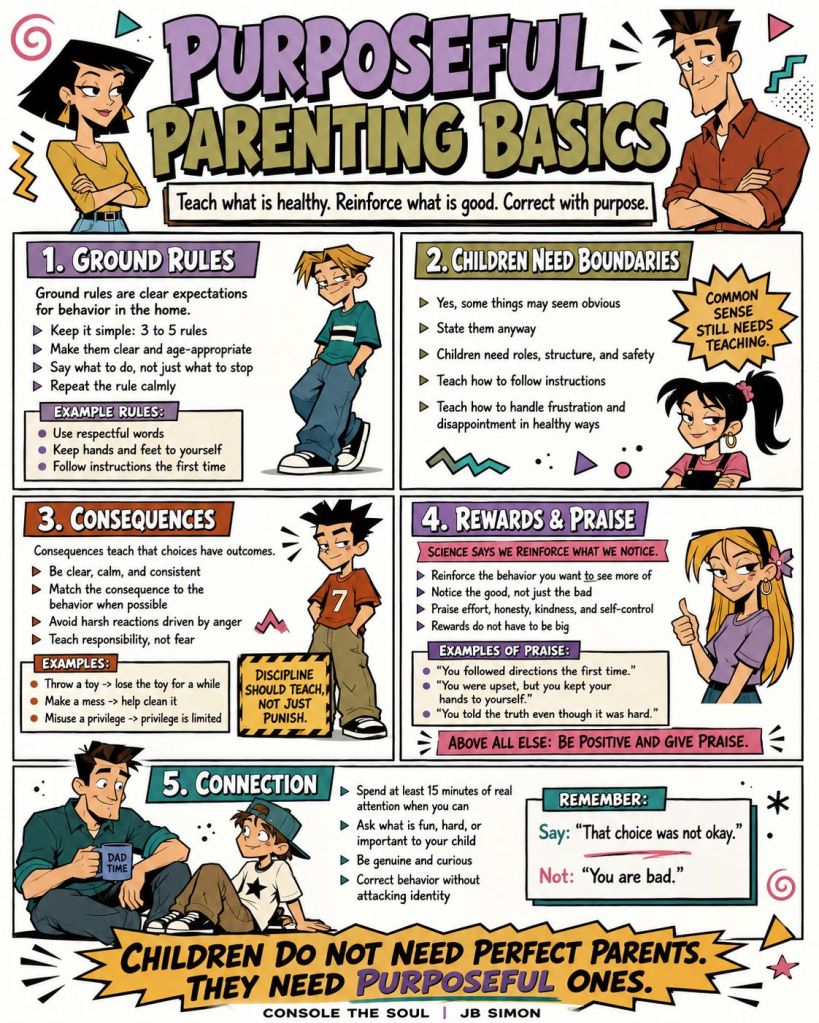
Yes, some of this may seem obvious. Yes, maybe children “should already know better.” Yes, maybe it feels ridiculous to state things that seem like common sense.
But we are going to state the obvious anyway.
Why?
Because parenting is teaching.
Children need roles. They need boundaries. They need structure. They need to know what is expected, what is not allowed, and what happens when a rule is broken.
They also need to know what they are doing well.
Above all else, be positive and give praise.
This is not just a cute parenting phrase. This is science. Behavior that gets reinforced is more likely to happen again. If you want to see more cooperation, honesty, kindness, responsibility, and self-control, then you must notice those behaviors and respond to them.
Not just the bad.
Not just the mistakes.
Not just the moments when you are irritated.
The good needs attention too.
What Is a Ground Rule?
A ground rule is a clear expectation for behavior in the home.
It tells the child what is allowed, what is not allowed, and how family members are expected to treat one another.
A good ground rule should be:
clear
simple
age-appropriate
easy to remember
stated positively when possible
connected to a consequence if broken
For example:
Instead of saying, “Stop acting wild,” say:
“No running in the house. Please walk.”
Instead of saying, “Quit being rude,” say:
“Use respectful words.”
Instead of saying, “Stop touching everything,” say:
“Keep your hands to yourself.”
The goal is to tell the child what to do, not only what not to do.
How Many Ground Rules Should You Have?
Keep it simple.
For most homes, start with about three to five ground rules.
Too many rules become noise. Children stop listening because everything feels equally important. Choose the rules that matter most for safety, respect, responsibility, and peace in the home.
Examples may include:
Use respectful words.
Keep your hands and feet to yourself.
Follow instructions the first time.
Take care of your responsibilities before play.
Respect people, property, and personal space.
You can adjust these depending on the age of the child and the needs of the household.
A toddler may need rules like:
“Gentle hands.” “Walking feet.” “Toys stay on the floor.”
A teenager may need rules like:
“Communicate where you are.” “Complete responsibilities before privileges.” “Speak respectfully, even when frustrated.”
The words may change, but the purpose remains the same.
Teach what is healthy.
Repeat the Rule Without Climbing the Ladder
When a rule is broken, restate the rule calmly.
Not with a speech.
Not with sarcasm.
Not with humiliation.
Not with a full family court hearing in the kitchen.
Just restate the rule.
“Our rule is no running in the house. Please walk.”
“Our rule is respectful words. Try again.”
“Our rule is chores before screen time. Finish your chore first.”
This teaches children to follow instructions. It also teaches them how to handle frustration and disappointment in a healthy way.
A child will not always like the rule.
That is okay.
A child may feel disappointed.
That is okay.
A child may need help learning how to be upset without becoming disrespectful, aggressive, or destructive.
That is part of the teaching.
Children Are Not Supposed to Be Perfect
Some adults have very little tolerance for mistakes.
A child spills something, and it becomes a character flaw.
A child forgets something, and suddenly they are “lazy.”
A child talks back, and now they are “bad.”
Be careful.
Do not impress upon your child that mistakes mean something is wrong with them.
Do not teach them that they must be perfect all the time to be acceptable.
Let us be for real.
That is not human.
Yes, we should teach values.
Yes, we should teach respect.
Yes, we should teach responsibility.
Yes, we should expect children to improve.
But we should also teach reality.
Human beings make mistakes. Human beings get frustrated. Human beings struggle with selfishness, laziness, anger, jealousy, fear, and impatience. Children are not born knowing how to manage all of that.
They have to be taught.
The goal is not to raise a child who never struggles.
The goal is to model positive behavior, positive thinking, responsibility, repair, and perseverance despite disappointments.
Consequences Matter
Consequences are a whole rabbit hole, but let us start at the surface.
There must be consequences for misbehavior.
A home without consequences teaches children that rules are optional.
However, consequences should be appropriate for the child, the behavior, the situation, and the values of the home.
A consequence should not simply be an emotional reaction from the parent.
It should teach something.
It should connect to responsibility.
It should help the child understand that choices have outcomes.
Examples:
If a child throws a toy, the toy is removed for a period of time.
If a child makes a mess on purpose, the child helps clean it.
If a child misuses screen time, screen time is limited.
If a child hurts someone, they must stop, calm down, and repair what they can.
If a child refuses a responsibility, a privilege may wait until the responsibility is completed.
Consequences should be clear, calm, and consistent.
Not random.
Not excessive.
Not based on how angry the parent feels in the moment.
Old School Parenting: The Good and the Problematic
I was raised in the South and around a very old-school parenting mindset.
There are some good things in old-school parenting.
Firmness can be good.
Structure can be good.
Respect can be good.
Consistent follow-through can be good.
Children do need to understand that adults are not their peers. They do need to follow reasonable instructions. They do need to learn that there is a time and place for certain conversations.
But there are also problems.
You cannot whip, spank, or beat a child for every single thing that goes wrong.
Every mistake does not need the harshest response.
Every behavior does not require physical discipline.
Before using physical discipline, a parent should ask some serious questions:
Am I doing this because it is truly needed, or because I want to release my anger?
Has this actually been effective with consistent results?
Has this created a barrier between me and my child in the area of trust and safety?
Am I prone to high emotions, rage, or losing control?
Am I teaching responsibility, or am I simply making my child afraid of me?
That is an honest conversation every parent needs to have with themselves.
Discipline should not be about revenge.
It should not be about embarrassment.
It should not be about proving power.
It should be about teaching.
Rewards Are Not Bribes
Some people hear the word “reward” and immediately reject it.
They say:
“I’m not thanking a child for doing what they were supposed to do.”
I understand that mindset.
Many of us were raised hearing:
“Do as you’re told.” “Nobody asked what you think.” “Stay out of grown folks’ conversation.” “You don’t get praised for responsibility.”
And yes, children should learn responsibility.
But praise is not the enemy of responsibility.
Praise helps children know what they are doing well.
Praise reinforces the behavior you want to see more of.
Praise builds connection.
Praise helps a child internalize, “I am capable of doing good. I can make wise choices. My effort matters.”
A reward does not always have to be candy, money, toys, or screen time.
Sometimes the reward is:
attention
praise
a smile
a hug
extra time together
choosing dinner
picking the family movie
staying up 15 minutes later
a small privilege
hearing, “I noticed that, and I’m proud of you.”
That matters.
Give Specific Praise
Do not only say, “Good job.”
Be specific.
Try:
“I noticed you helped your brother without being asked.”
“You were upset, but you kept your hands to yourself.”
“You followed directions the first time.”
“You told the truth even though it was hard.”
“You accepted no without continuing to argue.”
“You cleaned that up responsibly.”
Specific praise tells the child exactly what behavior to repeat.
It also teaches them that good behavior gets noticed too.
If the only time a child receives attention is when they are misbehaving, do not be surprised when misbehavior becomes loud.
Notice the good.
Reinforce the good.
Praise the good.
Spend Real Time With Your Child
Connection is also part of discipline.
Spend at least 15 consecutive minutes with your child when you can.
Not half-listening while scrolling.
Not asking questions while rushing.
Not giving instructions from another room.
Real attention.
Ask them:
What are you into right now?
What was good about your day?
What was hard today?
What feels fun to you?
What has been bothering you?
What do you wish adults understood better?
Be genuine.
Be curious.
This is a whole human being.
Your child has thoughts, feelings, interests, opinions, fears, and ideas. Just like you have your own personality, they have theirs.
In the early years, many children want to know you. They want to share with you. They want your attention and approval.
Use that time wisely.
Build the relationship before you need to correct the behavior.
Watch What Your Words Teach
Adults often remember criticism.
We remember the comments people made about our work, our body, our intelligence, our attitude, our mistakes, or our personality.
Children remember too.
They can internalize the negative things parents say about them.
So be mindful.
Correct behavior, but do not attack identity.
Say:
“That choice was not okay.”
Not:
“You are bad.”
Say:
“You need to redo this.”
Not:
“You never do anything right.”
Say:
“Use respectful words.”
Not:
“You are so disrespectful.”
There is a difference.
Correction should guide the child, not crush them.
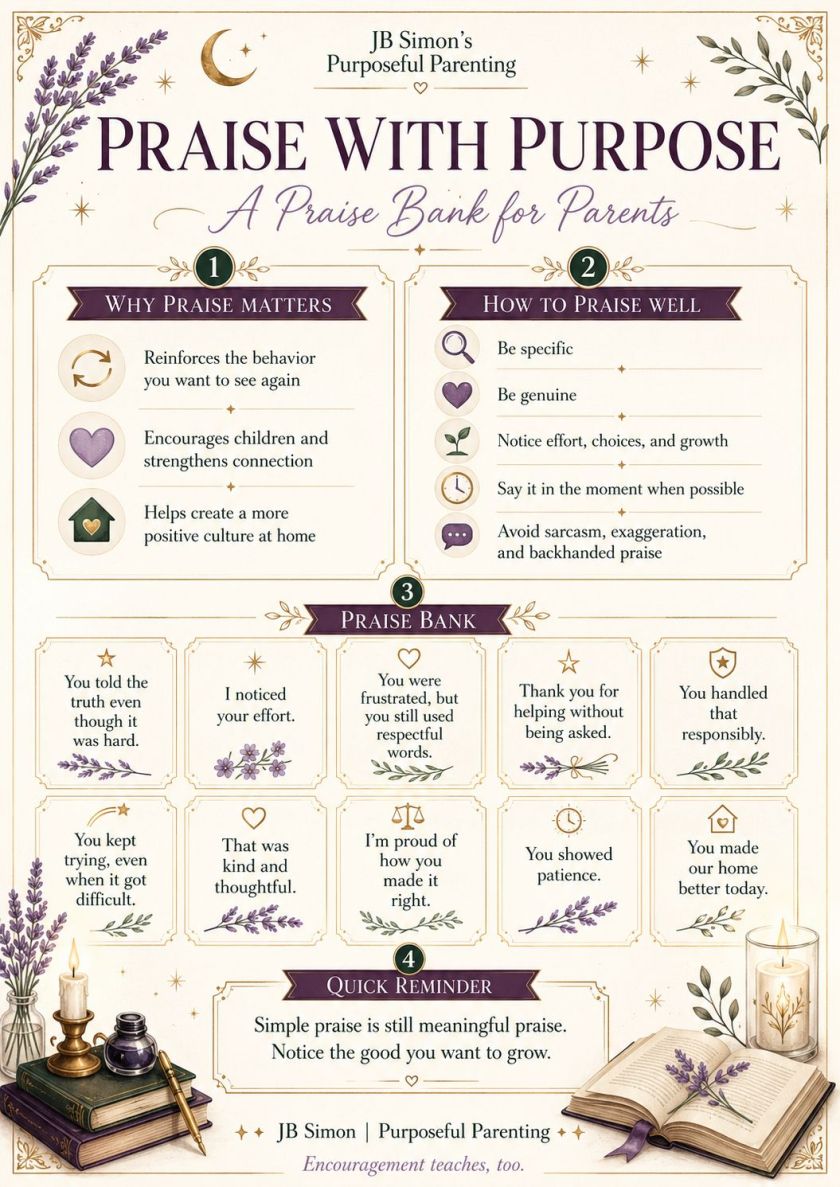
Looking for a simple way to encourage your child with more intention? This free Praise With Purpose printable is a quick parenting resource designed to help you notice the good, reinforce healthy behavior, and create a more positive culture at home.
Purposeful praise is not about exaggeration or empty compliments. It is about being specific, genuine, and encouraging. When we name effort, kindness, honesty, responsibility, patience, and growth, we help children understand what matters and which behaviors to practice again.
This free handout includes why praise matters, guidance for praising well, and a practical Praise Bank with examples you can begin using right away.
Tap or click the image to open the full-size printable.
Praise should not be random, exaggerated, or reserved only for major accomplishments. We should praise with intention.
There are many reasons to praise our children—and the people around us. Praise can reinforce healthy behavior, encourage someone who may be struggling, strengthen relationships, and teach us to become more observant, humble, and emotionally available.
The goal is not to flatter people or constantly announce that everything they do is amazing. The goal is to notice what is good, name it honestly, and encourage it to grow.
1. Praise Reinforces the Behavior We Want to See Again
In behavioral science, reinforcement is anything that increases the likelihood that a behavior will happen again. Praise can serve as a form of social reinforcement when it is connected to a specific behavior and matters to the person receiving it.
“Behavior that gets reinforced is more likely to happen again.”
When children demonstrate honesty, kindness, responsibility, patience, discipline, or self-control, those moments deserve attention.
Praise them when they tell the truth, especially when the truth is difficult. Praise them when they follow instructions without repeated arguing, keep their hands to themselves while angry, show kindness to a sibling, include someone who feels left out, admit a mistake, complete a responsibility, calm themselves after becoming upset, try again after failing, or make a wise choice when no one appears to be watching.
We often become highly observant when something goes wrong. We notice the shoes left in the hallway, the unfinished homework, the disrespectful tone, and the cup abandoned on the counter as though the kitchen fairy will eventually handle it.
But the good needs attention too.
As JB Simon explains in Purposeful Parenting Basics:
“Specific praise tells the child exactly what behavior to repeat.”
Instead of saying only, “Good job,” state what you noticed:
“You told the truth even though you thought you might get in trouble.”
“You were frustrated, but you still used respectful words.”
“I noticed that you helped your brother without being asked.”
“You kept working even when the assignment became difficult.”
“You cleaned up what you used. That was responsible.”
“You apologized and tried to repair what happened.”
Praise helps children connect their choices with the values we are trying to teach.
When we praise honesty, we strengthen honesty. When we praise self-control, we strengthen self-control. When we praise kindness, responsibility, perseverance, and repair, we communicate that these qualities matter in our home.
2. Praise Because People Need Encouragement
Not every encouraging word needs to be attached to a behavior plan.
Sometimes we praise simply because we want to be encouragers.
People often say, “You never know what a stranger is going through.” That is true—but heads up: you do not always know what the people living in your own home are going through either.
Your child may be dealing with embarrassment, rejection, insecurity, academic pressure, friendship problems, fear, grief, or questions they do not yet know how to express. Your spouse, friend, parent, coworker, or sibling may also be carrying something quietly.
We should not assume that proximity gives us complete access to another person’s internal world.
Children need adults who are willing to become their cheerleaders, sources of encouragement, and places of emotional safety. At the very least, that is what we should be striving to become.
“Connection is strengthened when we demonstrate love through patience, kind words, encouragement, affection, and a calm, steady presence.”
Praise is one way to communicate:
I see you.
I notice your effort.
Your growth matters.
Your presence has value.
You are more than your mistakes.
You do not have to perform perfectly to be loved.
That does not mean removing boundaries or pretending poor behavior is acceptable. Connection and correction can exist together.
As the same article reminds us:
“Correction may address the behavior in front of you, but connection helps shape the relationship beneath it.”
3. Praise Helps Adults Grow Too
Giving praise is not only beneficial for children. It also changes the adult giving it.
Intentional praise teaches us to slow down and observe.
What is my child doing well?
What progress have I ignored because it is not perfect yet?
Am I giving more attention to mistakes than growth?
Do the people in my home know what I appreciate about them?
Am I comfortable expressing positive emotions?
Do I believe people should “just know” that I love and value them?
Praise can require humility because it means acknowledging another person’s effort, growth, wisdom, or contribution. It can require vulnerability because some adults feel deeply uncomfortable saying, “I am proud of you,” “I appreciate you,” or “You handled that well.”
Perhaps your parents did not praise you. Perhaps affection and encouragement were rare in your home. Perhaps you were raised around criticism, sarcasm, emotional distance, or the belief that children should not be thanked for doing what they were supposed to do.
“Some people are learning the skill while trying to teach the skill.”
You may be learning how to encourage while raising a child who needs encouragement. You may be learning emotional expression while teaching your child to express emotions. You may be building a healthier household culture without having experienced one yourself.
That will feel awkward at first.
Do it anyway.
Praise Must Be Genuine
Children may appear gullible at times, but they can also be remarkably perceptive. They often recognize sarcasm, forced enthusiasm, manipulation, and praise that does not match reality.
Purposeful praise should be genuine, specific, timely, proportionate, and connected to effort, choices, values, or growth. It should be offered without sarcasm or a hidden insult.
Avoid exaggerated statements such as “You are perfect,” “You are the best at everything,” or “Look who finally decided to clean up.”
That last one is not praise. It is criticism wearing a party hat.
Try stating the obvious instead:
“You put your shoes away.”
“You remembered without being reminded.”
“You practiced patience with your sister.”
“You asked for help instead of giving up.”
“You handled that disappointment better than you did last time.”
“You made a mistake and took responsibility.”
Simple praise is still meaningful praise.
Create a Culture of Encouragement
You create the culture of your home.
As the parent and household leader, you help establish what becomes normal. If encouragement feels unfamiliar, begin practicing it until it becomes part of the family’s language.
“Ground rules are not about control. Ground rules are about teaching.”
Praise is also teaching.
It teaches children which values matter. It teaches them how to recognize goodness in themselves and others. It teaches them how encouragement sounds so they can eventually offer it to siblings, friends, classmates, coworkers, partners, and their own children.
You can begin with a simple family goal: Notice and name one positive thing each day.
“Thank you for being patient.”
“I appreciate how you helped.”
“You showed courage today.”
“You were thoughtful.”
“I noticed your effort.”
“You handled that responsibly.”
“I enjoy spending time with you.”
“I love the way your mind works.”
“You made our home better today.”
The words do not need to be extravagant. They need to be sincere.
Use the Praise Bank
The accompanying Praise Bank infographic provides examples for moments when you feel lost, awkward, or unsure of what to say.
Use it as a starting point—not a script that must be recited perfectly.
Choose a sentence. Say it honestly. Be specific when possible.
Ignore the initial awkwardness and lean into the practice. What feels unfamiliar today can become the new normal tomorrow.
Author’s Note: This article was written by JB Simon and edited with AI-assisted support for grammar, clarity, structure, and flow. The ideas, voice, and professional perspective are the author’s own.
Educational Notice: This article is for general parenting and wellness education. It is not a substitute for individualized mental-health, medical, legal, or crisis support.




 Console the Soul