Posted in Free Handouts, Printables

Free Printable: Steady Self Needs Check-In

When life feels “off,” the first question does not always have to be, “What is wrong with me?” Sometimes a better question is: What need is asking for attention?

The Steady Self Needs Check-In is a simple reflection worksheet designed to help you notice what currently feels supported—and what may need a little more care.

Inspired by Maslow’s hierarchy of needs and aligned with the Steady Self Model, the worksheet walks through five areas: physical needs, safety and rest, love and belonging, confidence and esteem, and growth and purpose.

Steady Self Needs Check-In printable worksheet using Maslow's hierarchy of needs and the Steady Self model

How to Use It

  • Print the worksheet or open it on a device.
  • Move through each level and write one or two things that help you feel steady, supported, and well.
  • Notice which level currently feels strongest.
  • Identify one area that may need more care.
  • Choose one realistic action instead of trying to fix everything at once.

Know your needs. Strengthen your foundation. Grow with intention.

This worksheet is meant for reflection and wellness education, not diagnosis. Return to it whenever you feel scattered, overwhelmed, stuck, or simply want to check whether the life you are building is supporting the person living it.

JB Simon
Console the Soul | Wellness & Resilience Education

Posted in Free Handouts, Printables, Resources

Free Printable: Steady Self Needs Check-In

Before we ask, “What is wrong with me?” it can help to ask, “What do I need?”

The Steady Self Needs Check-In is a simple reflection worksheet designed to help you slow down, identify what feels steady, notice what may need support, and choose one realistic next step.

Preview of the Steady Self Needs Check-In free printable worksheet

What This Worksheet Helps You Notice

The worksheet uses a Maslow-inspired view of human needs alongside the Steady Self idea: when something feels off, we can pause long enough to understand the need underneath the reaction.

  • Basic needs: Am I eating, sleeping, hydrating, and caring for my body?
  • Safety: Do I feel physically, emotionally, financially, and environmentally secure?
  • Connection: Do I have supportive relationships and a sense of belonging?
  • Esteem: How am I treating myself? Do I feel capable, respected, and confident enough to act?
  • Growth and purpose: What am I working toward, and what feels meaningful right now?

How to Use It

You do not have to “complete” every level before moving forward. Needs can overlap, change, and require maintenance throughout life. Use the worksheet as a check-in—not a test.

Fill in the spaces honestly. Circle what stands out. Then choose one area that deserves attention and identify one small action that could make that part of your life steadier.

Know your needs. Strengthen your foundation. Grow with intention.

This worksheet is intended for personal reflection, psychoeducation, and general wellness. It is not a diagnostic assessment or substitute for individualized mental-health care.

Posted in Free Handouts, Printables

Free Printable: Steady Self Needs Check-In

What need is asking for your attention right now?

The Steady Self Needs Check-In is a simple reflection tool designed to help you slow down, look at the different areas supporting your well-being, and identify where you may need a little more care.

It is inspired by Maslow’s hierarchy of needs and adapted to fit the Steady Self approach: instead of asking, “What is wrong with me?” we can sometimes begin with, “What do I need?”

Preview of the Steady Self Needs Check-In free printable worksheet
Steady Self Needs Check-In — Console the Soul by JB Simon

How to Use the Worksheet

Move through each area and write one or two examples of what helps you feel supported. You do not need to “complete” one level before thinking about another. The goal is awareness, not perfection.

  • Physical Needs: What helps your body feel nourished and cared for?
  • Safety & Rest: What helps you feel secure, settled, and able to exhale?
  • Love & Belonging: Who and what helps you feel connected?
  • Confidence & Esteem: What strengthens your sense of capability and self-respect?
  • Growth & Purpose: What keeps you learning, growing, and moving toward a meaningful life?

At the bottom, identify the need level that currently feels strongest and the one that may need more attention. That small comparison can help you choose a realistic next step instead of trying to fix everything at once.

Know your needs. Strengthen your foundation. Grow with intention.

Educational note: This worksheet is intended for reflection and general wellness education. Maslow’s hierarchy is a useful framework, but human needs can overlap and do not always occur in a strict step-by-step order.

JB Simon
Console the Soul | Wellness & Resilience Education

Posted in Free Handouts, Resources

Free Printable: Praise With Purpose

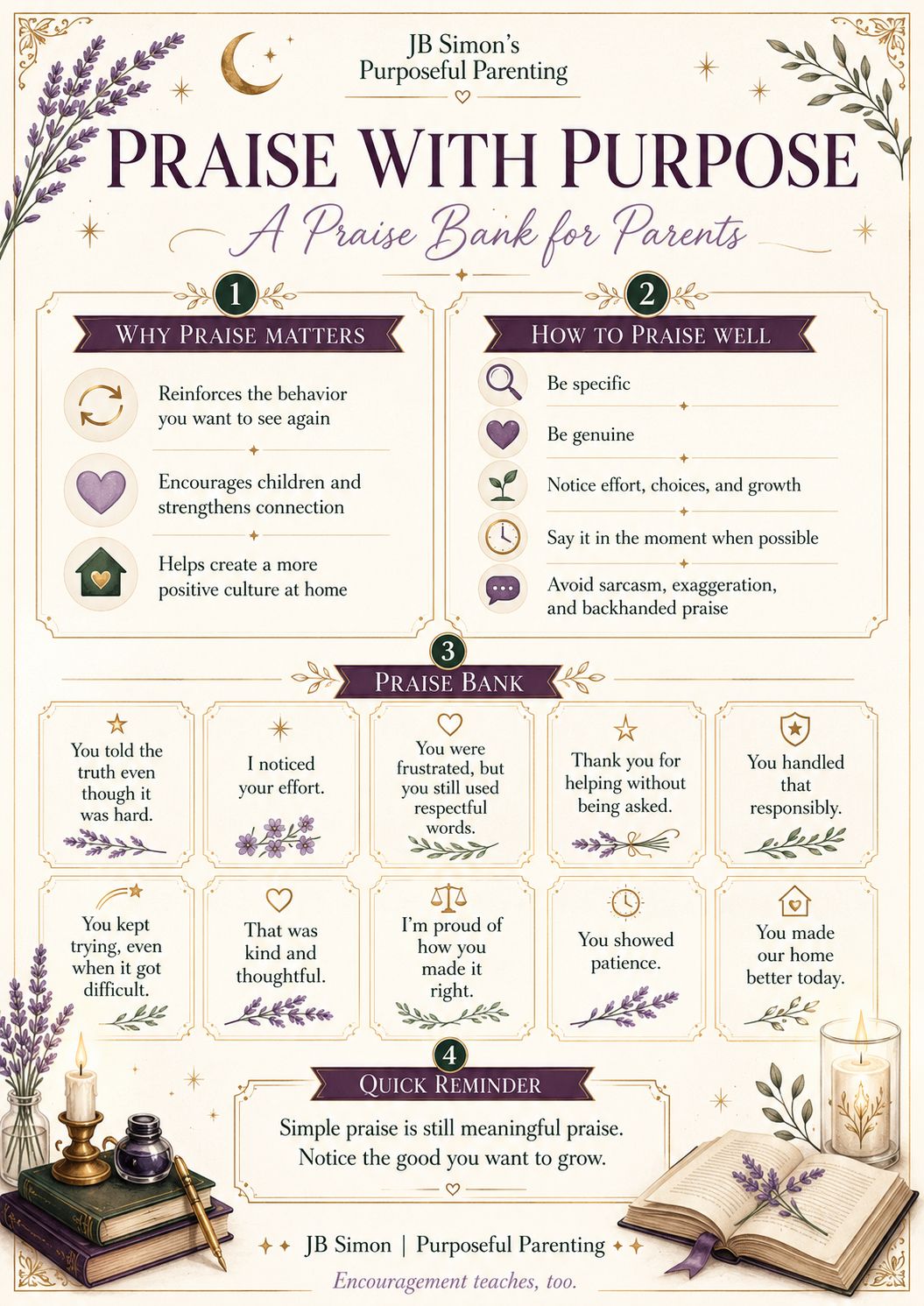
Looking for a simple way to encourage your child with more intention? This free Praise With Purpose printable is a quick parenting resource designed to help you notice the good, reinforce healthy behavior, and create a more positive culture at home.

Purposeful praise is not about exaggeration or empty compliments. It is about being specific, genuine, and encouraging. When we name effort, kindness, honesty, responsibility, patience, and growth, we help children understand what matters and which behaviors to practice again.

This free handout includes why praise matters, guidance for praising well, and a practical Praise Bank with examples you can begin using right away.

Praise With Purpose printable featuring reasons praise matters, tips for praising well, and a praise bank of encouraging phrases for parents.
Tap or click the image to open the full-size printable.

After opening the full-size image, use your browser or device options to save or print it.

Read the Full Article

For more guidance on reinforcement, genuine encouragement, specific praise, and creating a positive family culture, read Praise With Purpose: Notice the Good You Want to Grow.

Simple praise is still meaningful praise. Notice the good you want to grow.

JB Simon

Posted in Free Handouts, Resources

Free Printable: 5 Conversations Every Parent Should Have to Keep Their Kids Safe

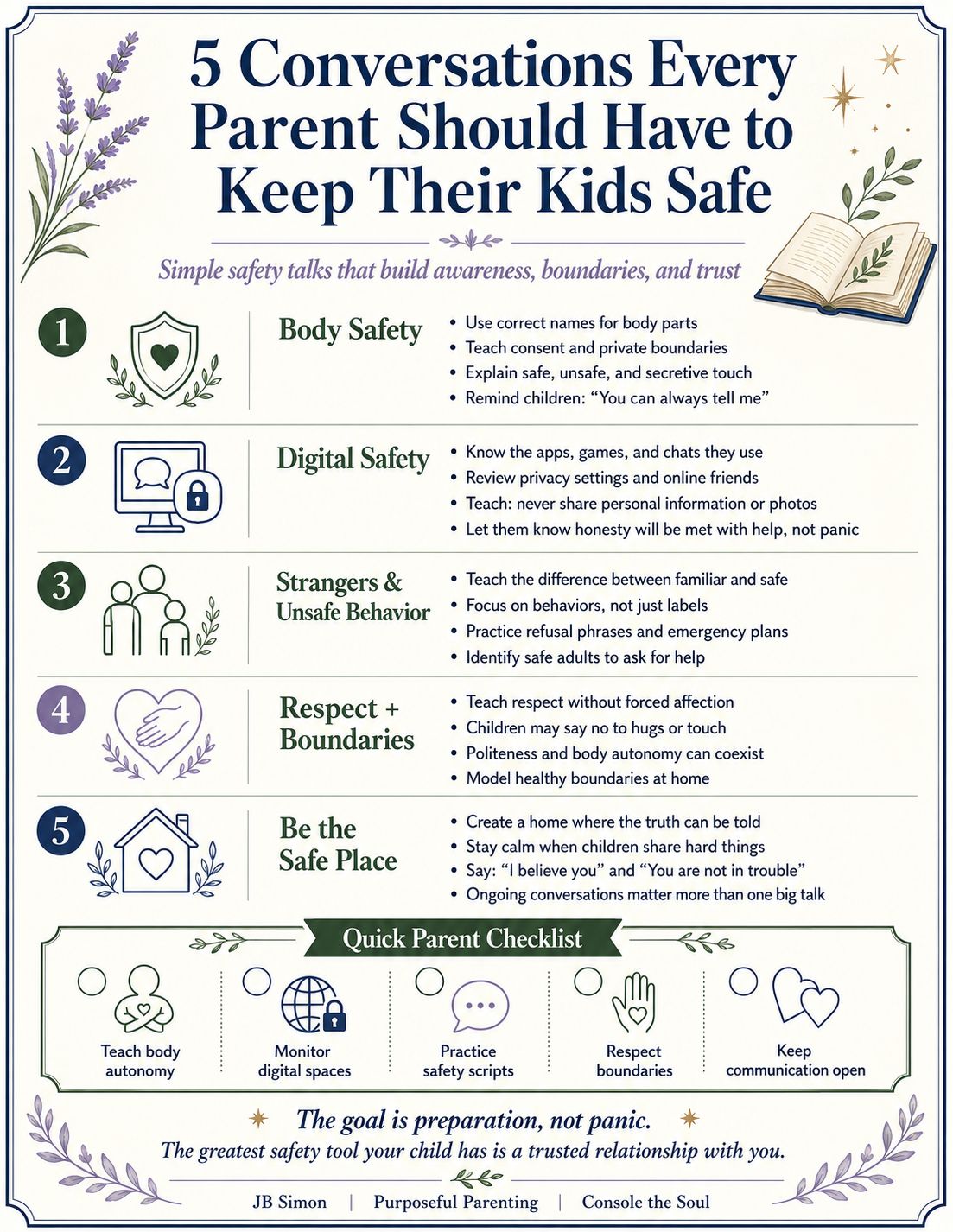
Parents do not need to approach child safety with panic. Children need calm, ongoing conversations that give them language, boundaries, confidence, and a safe adult they can always tell.

This free parent handout summarizes five essential safety conversations: body safety, digital safety, unsafe behavior, respectful boundaries, and becoming the safe place your child can come to.

Free printable infographic titled 5 Conversations Every Parent Should Have to Keep Their Kids Safe
Tap or click the infographic to open the full-size printable.

After opening the full-size image, use your browser or device options to save or print it.

Read the Full Parenting Guide

The printable is a quick reference. For explanations, examples, safety scripts, and practical guidance, read 5 Conversations Every Parent Should Have to Keep Their Kids Safe.

The goal is preparation, not panic. Keep the conversation calm, age-appropriate, and ongoing as your child grows.

Posted in Resources

FREE PRINTABLE

The Cycle of Steadiness Framework is a simple, holistic guide to understanding how spiritual, physical, and mental wellness work together. This free printable is designed to help you reflect on the areas of your life that may need more care, balance, and attention. Download it, color it, journal with it, or keep it somewhere visible as a reminder that wellness is not about perfection—it is the ongoing practice of returning to steadiness. Join the JB Simon email list for more free printables, wellness reflections, parenting resources, journaling prompts, and updates from Console the Soul.

Posted in Journal Prompts

5 Things I Do for Fun: A Guided Journal Prompt

Fun can look simple on the surface, but the things we choose for enjoyment often reveal something deeper. They can show us how we connect, how we recharge, what we value, what we avoid, and what parts of ourselves may need more room to breathe.

This journal prompt begins with an easy question, then invites you to look beneath your answers.

List five things you do for fun.

Do not choose what sounds productive, impressive, or socially acceptable. Choose the activities you genuinely enjoy—or used to enjoy before life became busy.

The General Prompt

Write down five activities that bring you pleasure, energy, peace, connection, curiosity, or relief. Beside each activity, answer the following:

  • What do I enjoy most about this activity?
  • Do I enjoy the activity itself, the people involved, the atmosphere, or how I feel afterward?
  • Does this energize me, calm me, challenge me, or help me escape?
  • Do I prefer to do it alone, with one person, or in a group?
  • How often do I actually make time for it?
  • What usually prevents me from doing it more often?
  • Does this activity reflect who I am now, who I used to be, or who I am becoming?

Questions That Promote Deeper Insight

After completing your list, use these questions to notice patterns.

  • Which of your five activities involve creativity?
  • Which involve movement, learning, nature, competition, music, beauty, or connection?
  • Which activity makes you feel most like yourself?
  • Which activity do you keep postponing even though you know it would help you?
  • Are your current hobbies restorative, or are some of them mainly distractions?
  • Do you allow yourself to enjoy things without earning the right to rest first?
  • When did you last try something new purely because it looked enjoyable?
  • What did you love doing as a child that you have abandoned as an adult?
  • What would your list look like if money, transportation, time, fear, or other people’s opinions were not barriers?
  • Which activity would you like to add to your life during the next year?

Favorite Animal Reflection

Your favorite animal can also serve as a useful reflection tool. The point is not to prove that an animal has a fixed symbolic meaning. The point is to notice what you admire, fear, or recognize in it.

  • What is your favorite animal?
  • What qualities do you associate with it?
  • Which of those qualities do you have in common?
  • Are these your best qualities, your most difficult qualities, or both?
  • When does that trait help you?
  • When does it create problems?
  • What trait do you admire in the animal but have not fully developed in yourself?
  • What would a healthier, more balanced expression of that trait look like?

For example, independence can be a strength when it creates confidence and resourcefulness. It can become a weakness when it turns into isolation, refusal to ask for help, or emotional distance. Loyalty can create deep connection, but it may also keep someone attached to people or situations that no longer feel safe or healthy.

My Example: Five Things I Do for Fun

I live in a small town in Southwest Louisiana. There are not endless entertainment options nearby. The movie theater is a drive, many events are farther away, and spontaneous outings usually require planning. Living in a small town has taught me that fun often requires creativity, intention, and the willingness to make something out of what is available.

1. Games

I enjoy arcades, family game nights, playful competition, and the energy that comes from people laughing together. I like the games, but the deeper reward is connection. Games create a temporary space where everyone can stop thinking about tomorrow’s responsibilities and be present.

What this reveals: I enjoy stimulation, challenge, humor, and shared experiences. Even though I value solitude, I also need moments of lively connection.

2. Painting

I am self-taught and still a work in progress. That is part of what makes painting meaningful. I enjoy blending colors, building an image, and watching something slowly take shape. At first, I only painted what someone else showed me. Eventually, I became brave enough to paint what I felt.

What this reveals: Creativity helps me process emotions that may be difficult to explain directly. Painting also reminds me that confidence grows through practice, not perfection.

3. Thrift and Sale Shopping

I enjoy finding a good deal, especially on cardigans, handbags, books, beauty items, and unusual pieces. Shopping on a budget becomes a kind of treasure hunt. Part of the fun is not knowing what I will find.

What this reveals: I appreciate beauty, possibility, and resourcefulness. I like taking overlooked things and recognizing their value. The question I still need to ask myself is whether I am shopping for enjoyment, collecting for a purpose, or using the thrill of finding something new to manage stress.

4. DIY Projects and Crafts

Flower arrangements, centerpieces, Sunday school crafts, ornaments, journals, and small creative projects all appeal to me. I enjoy turning ordinary materials into something useful, meaningful, or beautiful.

What this reveals: I do not only want to consume beauty; I want to create it. Making things gives my hands somewhere to place the ideas moving through my mind.

5. Live Music

I am an ambivert. I enjoy quiet hobbies that help me recharge, but I also need occasions that pull me out of the house. Live music offers movement, atmosphere, friendship, and the chance to feel part of something larger for a few hours.

What this reveals: My best life probably needs both solitude and community. Too much social activity drains me, but too much isolation can make life feel smaller than it should.

What My Favorite Animal Reveals

My favorite animal is the wolf. I associate wolves with strength, intelligence, loyalty, instinct, leadership, and the ability to survive alone when necessary. I recognize several of those qualities in myself.

Some are among my best qualities. I can be independent, observant, persistent, protective, and comfortable thinking for myself. Those same qualities can become difficult when independence turns into emotional distance, observation turns into overanalysis, or self-protection makes it hard to trust others.

The wolf reflection reminds me that being capable of standing alone does not mean I should always choose isolation. Strength can include accepting support. Leadership can include listening. Loyalty can include loyalty to my own well-being.

The Activities I Want to Add

A meaningful list should not only describe the past. It can also point toward growth. I would like travel to become one of the things I regularly do for fun. I also want more movement-based enjoyment, such as hiking, walking new trails, stretching, or eventually jogging.

This leads to another useful question: What kind of fun would support the person you are becoming?

  • Do you need more adventure or more rest?
  • More community or more solitude?
  • More movement or more stillness?
  • More creativity or more structure?
  • More novelty or more consistency?

Closing Reflection

Fun is not meaningless simply because it is enjoyable. Healthy leisure can reconnect us with curiosity, play, creativity, movement, and other people. It can also help us notice when something has changed.

If activities that once mattered to you no longer feel interesting, pause and pay attention. Ask whether you are exhausted, overwhelmed, disconnected, grieving, or simply ready for something new. Persistent loss of interest may be a sign that you need additional care or support.

Final journal question: What does your idea of fun reveal about what your mind, body, and spirit need more of right now?

— JB Simon
Posted in Journal Prompts

My Favorite Animal: A Research and Self-Reflection Journal Prompt

Our favorite animals can tell us something—not because animals function as personality tests, but because the traits we notice often reflect our values, longings, fears, and self-image.

This journal prompt combines intrapersonal reflection with research and learning. You will begin with your personal response, study the real animal, then compare your assumptions with what you discover.

Journal Prompt: What is your favorite animal, and what do you believe your choice reveals about you?

Part One: Begin With Your First Impression

Before researching the animal, write what immediately comes to mind.

  • What is your favorite animal?
  • When did you first become drawn to it?
  • What three words describe it in your mind?
  • What emotions do you associate with it?
  • What stories, movies, books, art, faith traditions, or childhood experiences shaped your opinion?
  • Do you admire the animal, identify with it, fear it, or wish to become more like it?
Wolf resting near the edge of a forest
Photo by Toby Christopher on Pexels.com

Part Two: Research the Real Animal

Now move from symbolism to evidence. Use reliable sources such as museums, universities, national parks, wildlife agencies, conservation organizations, and peer-reviewed research.

  • Where does the animal live?
  • What does it eat?
  • How does it communicate?
  • Does it live alone, in pairs, in family groups, or in changing social structures?
  • How does it care for young?
  • What role does it play in its ecosystem?
  • What threats does it face?
  • Which popular beliefs about it are accurate?
  • Which beliefs are exaggerated, outdated, or based on fiction?
  • What fact surprised you most?

Keep two columns in your journal: What I Believed and What I Learned. The difference between the two is part of the growth.

Part Three: Compare the Animal With Yourself

After researching, return to the traits you originally listed.

  • Which qualities do you genuinely share with this animal?
  • Which qualities belong more to the animal’s symbolic image than to its actual behavior?
  • Are the shared traits among your best qualities, your most difficult qualities, or both?
  • When does each trait help you?
  • When does it become unbalanced?
  • What quality do you admire but have not yet developed?
  • What quality do you need to soften, strengthen, or redirect?
  • What does your choice reveal about what you value in relationships?
  • What might it reveal about how you respond to stress, leadership, conflict, solitude, or belonging?

For example, independence may be a strength when it supports confidence and resourcefulness. It may become a weakness when it turns into isolation, emotional distance, or refusal to ask for help. Loyalty may create deep connection, but it can also keep a person attached to unhealthy situations.

Part Four: Turn Insight Into Growth

  • What is one quality you want to practice more intentionally?
  • What is one “shadow side” of that quality you need to watch?
  • What relationship, habit, or goal would improve if you expressed this trait in a healthier way?
  • What is one action you can take this week?

Reflective writing is most useful when it moves beyond description. Research on reflective writing in educational settings suggests that structured reflection can support self-awareness, learning, critical thinking, and the ability to examine one’s experiences more carefully. It is not a diagnosis, and it does not reveal a fixed personality. It is a tool for noticing patterns and choosing what to do with them.


My Example: Why the Wolf Is My Favorite Animal

My favorite animal is the wolf. I have always found wolves beautiful and majestic. Their appearance seems graceful and powerful at the same time. I am drawn to their strength, intelligence, loyalty, instinct, and ability to survive difficult environments.

My first three words were:

  • Beauty
  • Social intelligence
  • Power

Media, books, fantasy stories, and art have probably strengthened my attachment to wolves. However, the connection also feels personal. I see parts of myself in the traits I associate with them: independence, observation, loyalty, protectiveness, persistence, and the ability to lead or stand alone.

Woman outdoors near a wolf
Photo by Dmitriy Ganin on Pexels.com

What Research Added

Research made the reflection more accurate. Wild gray wolves are highly social animals. Their packs are commonly family groups made up of a breeding pair, their offspring, and sometimes other adults. They cooperate in raising young, hunting, defending territory, and caring for members of the group.

The phrase “lone wolf” creates an image of an animal that permanently rejects connection. In reality, wolves often spend time alone while dispersing from the family pack to find territory, a mate, or another pack. Solitude can be part of transition—not necessarily a lifelong preference.

I also learned to be careful with the familiar “alpha wolf” idea. The term became popular through observations of unrelated wolves living together in captivity. In the wild, the adults leading a pack are usually the parents. Their role is often better understood as family leadership than a constant fight for domination.

Wolves communicate through howling, scent marking, body posture, facial expression, and movement. They are also important predators within their ecosystems and can influence prey populations and the wider food web.

What the Wolf Reflection Reveals About Me

I recognize both strengths and risks in the qualities I admire.

  • Independence helps me think for myself and remain capable under pressure. Its shadow side is isolation and difficulty accepting support.
  • Observation helps me notice patterns and understand people. Its shadow side is overanalysis.
  • Protectiveness supports loyalty and care. Its shadow side is becoming guarded or controlling when I feel unsafe.
  • Leadership helps me organize, teach, and create direction. Its shadow side is carrying too much alone or becoming impatient with slower processes.
  • Solitude helps me recover and think clearly. Its shadow side is using distance to avoid vulnerability.

The research changed the metaphor in an important way. A wolf may be able to survive alone, but much of its strength is expressed through relationship, cooperation, communication, and family structure. That challenges the idea that strength means needing no one.

Close-up photograph of a wolf resting on the ground
Photo by Pixabay on Pexels.com

My Growth Question

How can I remain independent, observant, and strong without confusing self-protection with emotional isolation?

My action step is to practice asking for support before I am overwhelmed—not after. I can still value solitude while making room for connection. I can lead without assuming I must carry everything. I can be guarded wisely without closing every door.

Research and Reflection Checklist

  • I wrote my first impression before researching.
  • I used more than one reliable source.
  • I separated facts from symbolism.
  • I identified at least one assumption that changed.
  • I named both the strength and shadow side of an admired trait.
  • I chose one practical growth step.

Final Journal Questions

  • What does your favorite animal symbolize to you?
  • What does the real animal teach you that the symbol does not?
  • Which admired quality already lives in you?
  • Which quality needs a healthier balance?
  • What did your research correct or complicate?
  • What will you do differently because of what you learned?

Your favorite animal may not define you, but your reasons for choosing it can help you understand what you admire, protect, fear, and hope to become.

— JB Simon

Sources for Further Learning