Posted in Purposeful Parenting

Purposeful Parenting Basics:

Ground Rules, Consequences, and Rewards

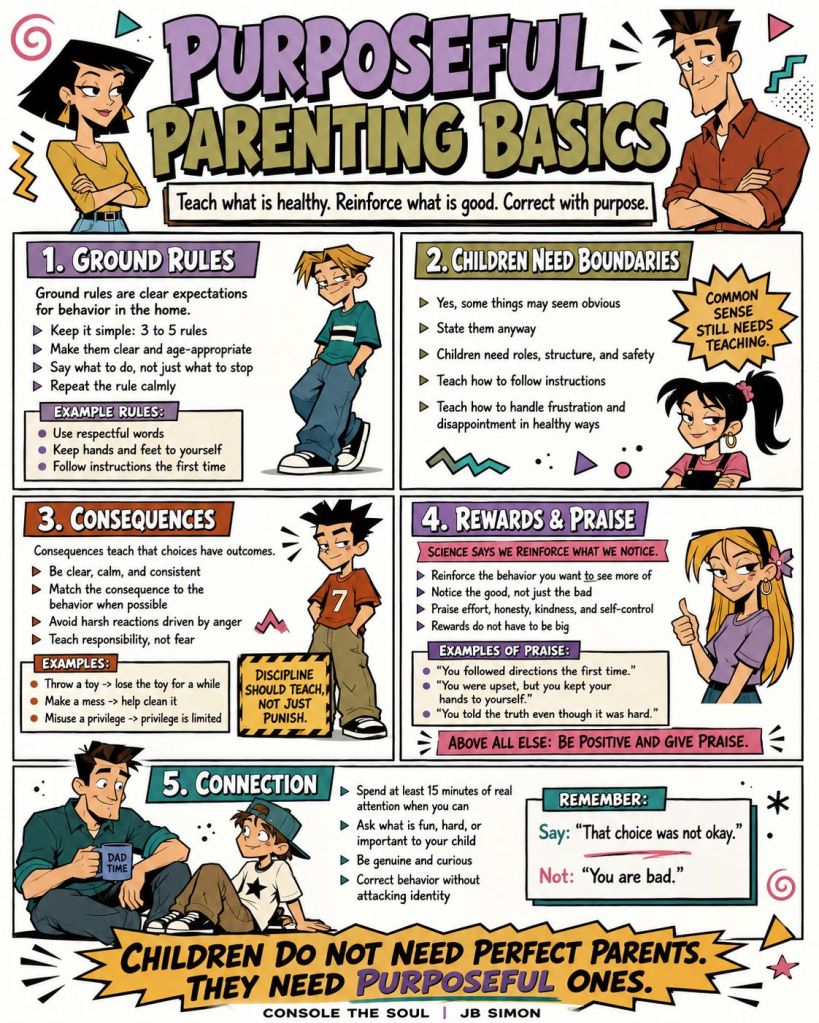
Teach what is healthy. Reinforce what is good. Correct with purpose.

There are a few basics in parenting that sound simple because they are simple.

Ground rules.
Consequences.
Rewards.
Praise.
Consistency.

Yes, some of this may seem obvious. Yes, maybe children “should already know better.” Yes, maybe it feels ridiculous to state things that seem like common sense.

But we are going to state the obvious anyway.

Why?

Because parenting is teaching.

Children need roles. They need boundaries. They need structure. They need to know what is expected, what is not allowed, and what happens when a rule is broken.

They also need to know what they are doing well.

Above all else, be positive and give praise.

This is not just a cute parenting phrase. This is science. Behavior that gets reinforced is more likely to happen again. If you want to see more cooperation, honesty, kindness, responsibility, and self-control, then you must notice those behaviors and respond to them.

Not just the bad.

Not just the mistakes.

Not just the moments when you are irritated.

The good needs attention too.

What Is a Ground Rule?

A ground rule is a clear expectation for behavior in the home.

It tells the child what is allowed, what is not allowed, and how family members are expected to treat one another.

A good ground rule should be:

  • clear
  • simple
  • age-appropriate
  • easy to remember
  • stated positively when possible
  • connected to a consequence if broken

For example:

Instead of saying, “Stop acting wild,” say:

“No running in the house. Please walk.”

Instead of saying, “Quit being rude,” say:

“Use respectful words.”

Instead of saying, “Stop touching everything,” say:

“Keep your hands to yourself.”

The goal is to tell the child what to do, not only what not to do.

How Many Ground Rules Should You Have?

Keep it simple.

For most homes, start with about three to five ground rules.

Too many rules become noise. Children stop listening because everything feels equally important. Choose the rules that matter most for safety, respect, responsibility, and peace in the home.

Examples may include:

  1. Use respectful words.
  2. Keep your hands and feet to yourself.
  3. Follow instructions the first time.
  4. Take care of your responsibilities before play.
  5. Respect people, property, and personal space.

You can adjust these depending on the age of the child and the needs of the household.

A toddler may need rules like:

“Gentle hands.”
“Walking feet.”
“Toys stay on the floor.”

A teenager may need rules like:

“Communicate where you are.”
“Complete responsibilities before privileges.”
“Speak respectfully, even when frustrated.”

The words may change, but the purpose remains the same.

Teach what is healthy.

Repeat the Rule Without Climbing the Ladder

When a rule is broken, restate the rule calmly.

Not with a speech.

Not with sarcasm.

Not with humiliation.

Not with a full family court hearing in the kitchen.

Just restate the rule.

“Our rule is no running in the house. Please walk.”

“Our rule is respectful words. Try again.”

“Our rule is chores before screen time. Finish your chore first.”

This teaches children to follow instructions. It also teaches them how to handle frustration and disappointment in a healthy way.

A child will not always like the rule.

That is okay.

A child may feel disappointed.

That is okay.

A child may need help learning how to be upset without becoming disrespectful, aggressive, or destructive.

That is part of the teaching.

Children Are Not Supposed to Be Perfect

Some adults have very little tolerance for mistakes.

A child spills something, and it becomes a character flaw.

A child forgets something, and suddenly they are “lazy.”

A child talks back, and now they are “bad.”

Be careful.

Do not impress upon your child that mistakes mean something is wrong with them.

Do not teach them that they must be perfect all the time to be acceptable.

Let us be for real.

That is not human.

Yes, we should teach values.

Yes, we should teach respect.

Yes, we should teach responsibility.

Yes, we should expect children to improve.

But we should also teach reality.

Human beings make mistakes. Human beings get frustrated. Human beings struggle with selfishness, laziness, anger, jealousy, fear, and impatience. Children are not born knowing how to manage all of that.

They have to be taught.

The goal is not to raise a child who never struggles.

The goal is to model positive behavior, positive thinking, responsibility, repair, and perseverance despite disappointments.

Consequences Matter

Consequences are a whole rabbit hole, but let us start at the surface.

There must be consequences for misbehavior.

A home without consequences teaches children that rules are optional.

However, consequences should be appropriate for the child, the behavior, the situation, and the values of the home.

A consequence should not simply be an emotional reaction from the parent.

It should teach something.

It should connect to responsibility.

It should help the child understand that choices have outcomes.

Examples:

  • If a child throws a toy, the toy is removed for a period of time.
  • If a child makes a mess on purpose, the child helps clean it.
  • If a child misuses screen time, screen time is limited.
  • If a child hurts someone, they must stop, calm down, and repair what they can.
  • If a child refuses a responsibility, a privilege may wait until the responsibility is completed.

Consequences should be clear, calm, and consistent.

Not random.

Not excessive.

Not based on how angry the parent feels in the moment.

Old School Parenting: The Good and the Problematic

I was raised in the South and around a very old-school parenting mindset.

There are some good things in old-school parenting.

Firmness can be good.

Structure can be good.

Respect can be good.

Consistent follow-through can be good.

Children do need to understand that adults are not their peers. They do need to follow reasonable instructions. They do need to learn that there is a time and place for certain conversations.

But there are also problems.

You cannot whip, spank, or beat a child for every single thing that goes wrong.

Every mistake does not need the harshest response.

Every behavior does not require physical discipline.

Before using physical discipline, a parent should ask some serious questions:

  • Am I doing this because it is truly needed, or because I want to release my anger?
  • Has this actually been effective with consistent results?
  • Has this created a barrier between me and my child in the area of trust and safety?
  • Am I prone to high emotions, rage, or losing control?
  • Am I teaching responsibility, or am I simply making my child afraid of me?

That is an honest conversation every parent needs to have with themselves.

Discipline should not be about revenge.

It should not be about embarrassment.

It should not be about proving power.

It should be about teaching.

Rewards Are Not Bribes

Some people hear the word “reward” and immediately reject it.

They say:

“I’m not thanking a child for doing what they were supposed to do.”

I understand that mindset.

Many of us were raised hearing:

“Do as you’re told.”
“Nobody asked what you think.”
“Stay out of grown folks’ conversation.”
“You don’t get praised for responsibility.”

And yes, children should learn responsibility.

But praise is not the enemy of responsibility.

Praise helps children know what they are doing well.

Praise reinforces the behavior you want to see more of.

Praise builds connection.

Praise helps a child internalize, “I am capable of doing good. I can make wise choices. My effort matters.”

A reward does not always have to be candy, money, toys, or screen time.

Sometimes the reward is:

  • attention
  • praise
  • a smile
  • a hug
  • extra time together
  • choosing dinner
  • picking the family movie
  • staying up 15 minutes later
  • a small privilege
  • hearing, “I noticed that, and I’m proud of you.”

That matters.

Give Specific Praise

Do not only say, “Good job.”

Be specific.

Try:

“I noticed you helped your brother without being asked.”

“You were upset, but you kept your hands to yourself.”

“You followed directions the first time.”

“You told the truth even though it was hard.”

“You accepted no without continuing to argue.”

“You cleaned that up responsibly.”

Specific praise tells the child exactly what behavior to repeat.

It also teaches them that good behavior gets noticed too.

If the only time a child receives attention is when they are misbehaving, do not be surprised when misbehavior becomes loud.

Notice the good.

Reinforce the good.

Praise the good.

Spend Real Time With Your Child

Connection is also part of discipline.

Spend at least 15 consecutive minutes with your child when you can.

Not half-listening while scrolling.

Not asking questions while rushing.

Not giving instructions from another room.

Real attention.

Ask them:

  • What are you into right now?
  • What was good about your day?
  • What was hard today?
  • What feels fun to you?
  • What has been bothering you?
  • What do you wish adults understood better?

Be genuine.

Be curious.

This is a whole human being.

Your child has thoughts, feelings, interests, opinions, fears, and ideas. Just like you have your own personality, they have theirs.

In the early years, many children want to know you. They want to share with you. They want your attention and approval.

Use that time wisely.

Build the relationship before you need to correct the behavior.

Watch What Your Words Teach

Adults often remember criticism.

We remember the comments people made about our work, our body, our intelligence, our attitude, our mistakes, or our personality.

Children remember too.

They can internalize the negative things parents say about them.

So be mindful.

Correct behavior, but do not attack identity.

Say:

“That choice was not okay.”

Not:

“You are bad.”

Say:

“You need to redo this.”

Not:

“You never do anything right.”

Say:

“Use respectful words.”

Not:

“You are so disrespectful.”

There is a difference.

Correction should guide the child, not crush them.

The Basics Still Work

Ground rules give structure.

Consequences teach responsibility.

Rewards and praise reinforce positive behavior.

Connection strengthens the relationship.

Consistency builds trust.

None of this has to be complicated.

Set the rule.

Teach the rule.

Repeat the rule.

Follow through when the rule is broken.

Praise the behavior you want to see again.

Spend real time with your child.

Model the values you expect.

And remember:

Children do not need perfect parents.

They need purposeful ones.

— JB Simon
Posted in Purposeful Parenting

Purposeful Parenting Basics:

Ground Rules, Consequences, and Rewards

Teach what is healthy. Reinforce what is good. Correct with purpose.

There are a few basics in parenting that sound simple because they are simple.

Ground rules.
Consequences.
Rewards.
Praise.
Consistency.

Yes, some of this may seem obvious. Yes, maybe children “should already know better.” Yes, maybe it feels ridiculous to state things that seem like common sense.

But we are going to state the obvious anyway.

Why?

Because parenting is teaching.

Children need roles. They need boundaries. They need structure. They need to know what is expected, what is not allowed, and what happens when a rule is broken.

They also need to know what they are doing well.

Above all else, be positive and give praise.

This is not just a cute parenting phrase. This is science. Behavior that gets reinforced is more likely to happen again. If you want to see more cooperation, honesty, kindness, responsibility, and self-control, then you must notice those behaviors and respond to them.

Not just the bad.

Not just the mistakes.

Not just the moments when you are irritated.

The good needs attention too.

What Is a Ground Rule?

A ground rule is a clear expectation for behavior in the home.

It tells the child what is allowed, what is not allowed, and how family members are expected to treat one another.

A good ground rule should be:

  • clear
  • simple
  • age-appropriate
  • easy to remember
  • stated positively when possible
  • connected to a consequence if broken

For example:

Instead of saying, “Stop acting wild,” say:

“No running in the house. Please walk.”

Instead of saying, “Quit being rude,” say:

“Use respectful words.”

Instead of saying, “Stop touching everything,” say:

“Keep your hands to yourself.”

The goal is to tell the child what to do, not only what not to do.

How Many Ground Rules Should You Have?

Keep it simple.

For most homes, start with about three to five ground rules.

Too many rules become noise. Children stop listening because everything feels equally important. Choose the rules that matter most for safety, respect, responsibility, and peace in the home.

Examples may include:

  1. Use respectful words.
  2. Keep your hands and feet to yourself.
  3. Follow instructions the first time.
  4. Take care of your responsibilities before play.
  5. Respect people, property, and personal space.

You can adjust these depending on the age of the child and the needs of the household.

A toddler may need rules like:

“Gentle hands.”
“Walking feet.”
“Toys stay on the floor.”

A teenager may need rules like:

“Communicate where you are.”
“Complete responsibilities before privileges.”
“Speak respectfully, even when frustrated.”

The words may change, but the purpose remains the same.

Teach what is healthy.

Repeat the Rule Without Climbing the Ladder

When a rule is broken, restate the rule calmly.

Not with a speech.

Not with sarcasm.

Not with humiliation.

Not with a full family court hearing in the kitchen.

Just restate the rule.

“Our rule is no running in the house. Please walk.”

“Our rule is respectful words. Try again.”

“Our rule is chores before screen time. Finish your chore first.”

This teaches children to follow instructions. It also teaches them how to handle frustration and disappointment in a healthy way.

A child will not always like the rule.

That is okay.

A child may feel disappointed.

That is okay.

A child may need help learning how to be upset without becoming disrespectful, aggressive, or destructive.

That is part of the teaching.

Children Are Not Supposed to Be Perfect

Some adults have very little tolerance for mistakes.

A child spills something, and it becomes a character flaw.

A child forgets something, and suddenly they are “lazy.”

A child talks back, and now they are “bad.”

Be careful.

Do not impress upon your child that mistakes mean something is wrong with them.

Do not teach them that they must be perfect all the time to be acceptable.

Let us be for real.

That is not human.

Yes, we should teach values.

Yes, we should teach respect.

Yes, we should teach responsibility.

Yes, we should expect children to improve.

But we should also teach reality.

Human beings make mistakes. Human beings get frustrated. Human beings struggle with selfishness, laziness, anger, jealousy, fear, and impatience. Children are not born knowing how to manage all of that.

They have to be taught.

The goal is not to raise a child who never struggles.

The goal is to model positive behavior, positive thinking, responsibility, repair, and perseverance despite disappointments.

Consequences Matter

Consequences are a whole rabbit hole, but let us start at the surface.

There must be consequences for misbehavior.

A home without consequences teaches children that rules are optional.

However, consequences should be appropriate for the child, the behavior, the situation, and the values of the home.

A consequence should not simply be an emotional reaction from the parent.

It should teach something.

It should connect to responsibility.

It should help the child understand that choices have outcomes.

Examples:

  • If a child throws a toy, the toy is removed for a period of time.
  • If a child makes a mess on purpose, the child helps clean it.
  • If a child misuses screen time, screen time is limited.
  • If a child hurts someone, they must stop, calm down, and repair what they can.
  • If a child refuses a responsibility, a privilege may wait until the responsibility is completed.

Consequences should be clear, calm, and consistent.

Not random.

Not excessive.

Not based on how angry the parent feels in the moment.

Old School Parenting: The Good and the Problematic

I was raised in the South and around a very old-school parenting mindset.

There are some good things in old-school parenting.

Firmness can be good.

Structure can be good.

Respect can be good.

Consistent follow-through can be good.

Children do need to understand that adults are not their peers. They do need to follow reasonable instructions. They do need to learn that there is a time and place for certain conversations.

But there are also problems.

You cannot whip, spank, or beat a child for every single thing that goes wrong.

Every mistake does not need the harshest response.

Every behavior does not require physical discipline.

Before using physical discipline, a parent should ask some serious questions:

  • Am I doing this because it is truly needed, or because I want to release my anger?
  • Has this actually been effective with consistent results?
  • Has this created a barrier between me and my child in the area of trust and safety?
  • Am I prone to high emotions, rage, or losing control?
  • Am I teaching responsibility, or am I simply making my child afraid of me?

That is an honest conversation every parent needs to have with themselves.

Discipline should not be about revenge.

It should not be about embarrassment.

It should not be about proving power.

It should be about teaching.

Rewards Are Not Bribes

Some people hear the word “reward” and immediately reject it.

They say:

“I’m not thanking a child for doing what they were supposed to do.”

I understand that mindset.

Many of us were raised hearing:

“Do as you’re told.”
“Nobody asked what you think.”
“Stay out of grown folks’ conversation.”
“You don’t get praised for responsibility.”

And yes, children should learn responsibility.

But praise is not the enemy of responsibility.

Praise helps children know what they are doing well.

Praise reinforces the behavior you want to see more of.

Praise builds connection.

Praise helps a child internalize, “I am capable of doing good. I can make wise choices. My effort matters.”

A reward does not always have to be candy, money, toys, or screen time.

Sometimes the reward is:

  • attention
  • praise
  • a smile
  • a hug
  • extra time together
  • choosing dinner
  • picking the family movie
  • staying up 15 minutes later
  • a small privilege
  • hearing, “I noticed that, and I’m proud of you.”

That matters.

Give Specific Praise

Do not only say, “Good job.”

Be specific.

Try:

“I noticed you helped your brother without being asked.”

“You were upset, but you kept your hands to yourself.”

“You followed directions the first time.”

“You told the truth even though it was hard.”

“You accepted no without continuing to argue.”

“You cleaned that up responsibly.”

Specific praise tells the child exactly what behavior to repeat.

It also teaches them that good behavior gets noticed too.

If the only time a child receives attention is when they are misbehaving, do not be surprised when misbehavior becomes loud.

Notice the good.

Reinforce the good.

Praise the good.

Spend Real Time With Your Child

Connection is also part of discipline.

Spend at least 15 consecutive minutes with your child when you can.

Not half-listening while scrolling.

Not asking questions while rushing.

Not giving instructions from another room.

Real attention.

Ask them:

  • What are you into right now?
  • What was good about your day?
  • What was hard today?
  • What feels fun to you?
  • What has been bothering you?
  • What do you wish adults understood better?

Be genuine.

Be curious.

This is a whole human being.

Your child has thoughts, feelings, interests, opinions, fears, and ideas. Just like you have your own personality, they have theirs.

In the early years, many children want to know you. They want to share with you. They want your attention and approval.

Use that time wisely.

Build the relationship before you need to correct the behavior.

Watch What Your Words Teach

Adults often remember criticism.

We remember the comments people made about our work, our body, our intelligence, our attitude, our mistakes, or our personality.

Children remember too.

They can internalize the negative things parents say about them.

So be mindful.

Correct behavior, but do not attack identity.

Say:

“That choice was not okay.”

Not:

“You are bad.”

Say:

“You need to redo this.”

Not:

“You never do anything right.”

Say:

“Use respectful words.”

Not:

“You are so disrespectful.”

There is a difference.

Correction should guide the child, not crush them.

The Basics Still Work

Ground rules give structure.

Consequences teach responsibility.

Rewards and praise reinforce positive behavior.

Connection strengthens the relationship.

Consistency builds trust.

None of this has to be complicated.

Set the rule.

Teach the rule.

Repeat the rule.

Follow through when the rule is broken.

Praise the behavior you want to see again.

Spend real time with your child.

Model the values you expect.

And remember:

Children do not need perfect parents.

They need purposeful ones.

— JB Simon

Posted in Journal Prompts

5 Things I Do for Fun: A Guided Journal Prompt

Fun can look simple on the surface, but the things we choose for enjoyment often reveal something deeper. They can show us how we connect, how we recharge, what we value, what we avoid, and what parts of ourselves may need more room to breathe.

This journal prompt begins with an easy question, then invites you to look beneath your answers.

List five things you do for fun.

Do not choose what sounds productive, impressive, or socially acceptable. Choose the activities you genuinely enjoy—or used to enjoy before life became busy.

The General Prompt

Write down five activities that bring you pleasure, energy, peace, connection, curiosity, or relief. Beside each activity, answer the following:

  • What do I enjoy most about this activity?
  • Do I enjoy the activity itself, the people involved, the atmosphere, or how I feel afterward?
  • Does this energize me, calm me, challenge me, or help me escape?
  • Do I prefer to do it alone, with one person, or in a group?
  • How often do I actually make time for it?
  • What usually prevents me from doing it more often?
  • Does this activity reflect who I am now, who I used to be, or who I am becoming?

Questions That Promote Deeper Insight

After completing your list, use these questions to notice patterns.

  • Which of your five activities involve creativity?
  • Which involve movement, learning, nature, competition, music, beauty, or connection?
  • Which activity makes you feel most like yourself?
  • Which activity do you keep postponing even though you know it would help you?
  • Are your current hobbies restorative, or are some of them mainly distractions?
  • Do you allow yourself to enjoy things without earning the right to rest first?
  • When did you last try something new purely because it looked enjoyable?
  • What did you love doing as a child that you have abandoned as an adult?
  • What would your list look like if money, transportation, time, fear, or other people’s opinions were not barriers?
  • Which activity would you like to add to your life during the next year?

Favorite Animal Reflection

Your favorite animal can also serve as a useful reflection tool. The point is not to prove that an animal has a fixed symbolic meaning. The point is to notice what you admire, fear, or recognize in it.

  • What is your favorite animal?
  • What qualities do you associate with it?
  • Which of those qualities do you have in common?
  • Are these your best qualities, your most difficult qualities, or both?
  • When does that trait help you?
  • When does it create problems?
  • What trait do you admire in the animal but have not fully developed in yourself?
  • What would a healthier, more balanced expression of that trait look like?

For example, independence can be a strength when it creates confidence and resourcefulness. It can become a weakness when it turns into isolation, refusal to ask for help, or emotional distance. Loyalty can create deep connection, but it may also keep someone attached to people or situations that no longer feel safe or healthy.

My Example: Five Things I Do for Fun

I live in a small town in Southwest Louisiana. There are not endless entertainment options nearby. The movie theater is a drive, many events are farther away, and spontaneous outings usually require planning. Living in a small town has taught me that fun often requires creativity, intention, and the willingness to make something out of what is available.

1. Games

I enjoy arcades, family game nights, playful competition, and the energy that comes from people laughing together. I like the games, but the deeper reward is connection. Games create a temporary space where everyone can stop thinking about tomorrow’s responsibilities and be present.

What this reveals: I enjoy stimulation, challenge, humor, and shared experiences. Even though I value solitude, I also need moments of lively connection.

2. Painting

I am self-taught and still a work in progress. That is part of what makes painting meaningful. I enjoy blending colors, building an image, and watching something slowly take shape. At first, I only painted what someone else showed me. Eventually, I became brave enough to paint what I felt.

What this reveals: Creativity helps me process emotions that may be difficult to explain directly. Painting also reminds me that confidence grows through practice, not perfection.

3. Thrift and Sale Shopping

I enjoy finding a good deal, especially on cardigans, handbags, books, beauty items, and unusual pieces. Shopping on a budget becomes a kind of treasure hunt. Part of the fun is not knowing what I will find.

What this reveals: I appreciate beauty, possibility, and resourcefulness. I like taking overlooked things and recognizing their value. The question I still need to ask myself is whether I am shopping for enjoyment, collecting for a purpose, or using the thrill of finding something new to manage stress.

4. DIY Projects and Crafts

Flower arrangements, centerpieces, Sunday school crafts, ornaments, journals, and small creative projects all appeal to me. I enjoy turning ordinary materials into something useful, meaningful, or beautiful.

What this reveals: I do not only want to consume beauty; I want to create it. Making things gives my hands somewhere to place the ideas moving through my mind.

5. Live Music

I am an ambivert. I enjoy quiet hobbies that help me recharge, but I also need occasions that pull me out of the house. Live music offers movement, atmosphere, friendship, and the chance to feel part of something larger for a few hours.

What this reveals: My best life probably needs both solitude and community. Too much social activity drains me, but too much isolation can make life feel smaller than it should.

What My Favorite Animal Reveals

My favorite animal is the wolf. I associate wolves with strength, intelligence, loyalty, instinct, leadership, and the ability to survive alone when necessary. I recognize several of those qualities in myself.

Some are among my best qualities. I can be independent, observant, persistent, protective, and comfortable thinking for myself. Those same qualities can become difficult when independence turns into emotional distance, observation turns into overanalysis, or self-protection makes it hard to trust others.

The wolf reflection reminds me that being capable of standing alone does not mean I should always choose isolation. Strength can include accepting support. Leadership can include listening. Loyalty can include loyalty to my own well-being.

The Activities I Want to Add

A meaningful list should not only describe the past. It can also point toward growth. I would like travel to become one of the things I regularly do for fun. I also want more movement-based enjoyment, such as hiking, walking new trails, stretching, or eventually jogging.

This leads to another useful question: What kind of fun would support the person you are becoming?

  • Do you need more adventure or more rest?
  • More community or more solitude?
  • More movement or more stillness?
  • More creativity or more structure?
  • More novelty or more consistency?

Closing Reflection

Fun is not meaningless simply because it is enjoyable. Healthy leisure can reconnect us with curiosity, play, creativity, movement, and other people. It can also help us notice when something has changed.

If activities that once mattered to you no longer feel interesting, pause and pay attention. Ask whether you are exhausted, overwhelmed, disconnected, grieving, or simply ready for something new. Persistent loss of interest may be a sign that you need additional care or support.

Final journal question: What does your idea of fun reveal about what your mind, body, and spirit need more of right now?

— JB Simon